

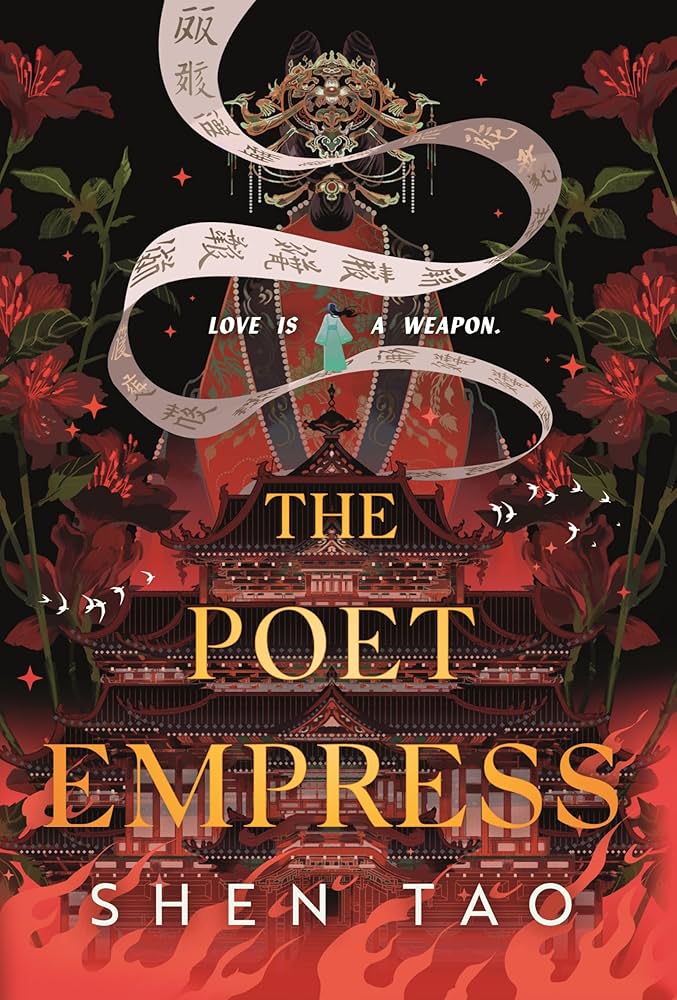
“It is true, he has suffered, but if everyone who suffered became monsters, the world would be overrun with them.”
 If If you have seen The Poet Empress floating around and thought, “oh yay/no, another enemies to lovers fantasy romance”, then I am here to tell you that you could not be more wrong. Think more like The Poppy War meets She Who Became the Sun meets The Dandelion Dynasty, except exchange the battlefields and blades in those books for battles of the mind, words as sharp as knives, and insidious schemes inside the palace halls. This book does not care about genre expectations, does not care about reader comfort, and frankly does not care about your emotional wellbeing. And honestly, I love it for that.
Now, I knew virtually nothing about The Poet Empress except that it was getting glowing praise from people I trust blindly, and that was enough for me to dive in headfirst with my expectations and excitement sky-high. And honestly, I have to admit that the first quarter didn’t instantly have me sold, not because it wasn’t good, but more because I was quite disturbed by everything that was going on and just did not fully see where Shen Tao was going with all of it. Spoiler alert, I should have just trusted the process, because this is a slow-burn done to absolute perfection, the kind that settles into your bones before you realize you are on fire.
Okay, before I start incoherently rambling, let’s go into what The Poet Empress is actually about. We follow Wei Yin, a rice-farmer’s daughter scraping out an existence in a dying empire ruled by a decaying dynasty. Famine is everywhere, women are forbidden from reading, and poetry magic (yes, actual magic bound to words and verse, we love to see it) is hoarded by the powerful as a means of control. Desperate to save her starving family, Wei offers herself as concubine to the brutal heir of the Azalea House, and what follows is not romance in any traditional sense, but an emotionally devastating exploration of power, love, betrayal, and the slow destruction required to survive systems built entirely on cruelty.
Wei could so easily have fallen into the ‘not like other girls’ strong female character stereotype, and yet she never does. Watching her navigate the cutthroat politics of the Azalea court had me glued to the page, and I loved how Tao explored with brutal honesty how prolonged exposure to the corruption of the court can change a person. Wei does not simply endure the palace, she adapts to it, absorbs it, and is reshaped by it over years of quiet compromises and survival-driven choices to accomplish her goals and protect the people she loves, and I both loved and hated that journey for her.
That said, I did feel a slight emotional distance from all the characters, even Wei. Despite the first-person narration, which usually makes me feel like I am living inside a character’s skin, most of the characters just did not really leap off the page with personality for me and the dialogue didn’t always feel as organic or sharp as I usually prefer. However, at times that distance almost felt intentional because of the epic, legendary quality of this story, and I think Shao’s gentle yet quietly devastating prose and storytelling suited this narrative beautifully.
Moreover, The Poet Empress just hits hard regardless of your level of emotional connection, because Tao just holds nothing back when it comes to exploring the cost of ambition, the way that power corrupts, the weight of systemic inequality and oppression, and the invisible scars of (childhood) trauma. Nothing and no one is safe in this book, and while none of the violence or graphic scenes felt gratuitous or for shock value, it still made my stomach turn to see Wei (and so many other people) suffering and being subjected to prolonged mental, emotional, and physical abuse.
And now that we are on the topic of brutality and monsters, we must talk about the morally gray enigma that is Prince Terren. Not gonna lie, I despised this cruel man with a burning passion for the majority of this book, yet I was also morbidly fascinated by him and he may or may not have ended up being my favourite character of the book for… we’re not going to talk about what that says about me, okay?
Anyway, the story really came alive for me when it introduced the ‘story within a story’ element, with Wei’s narration getting broken up by journal entries and conflicting stories of the royal family’s past. It absolutely ripped my heart to shreds as we went down memory lane with Terren and his older brother Maro to see exactly what could have been but was never meant to be, and I really appreciated how Tao showed his transformation from a sweet, damaged boy into a fully realized monster in real time without ever trying to redeem him. His trauma is contextualized but never used as an excuse, and I just loved the emotional devastation of it all.
Needless to say, the storytelling in The Poet Empress is exceedingly slow-burn and deeply character-driven, but the best thing is that the other aspects of the book never suffer for it. The lush Asian-inspired world-building had me so immersed and I was just enamoured with the concept of literomancy/poetry magic, especially because of how seamlessly Tao wove all of it into the politics, succession conflicts, character relationships, and Wei’s own forbidden literacy as a woman. And don’t mistake lack of action for lack of tension, because the stakes are viciously real and absolutely zero punches are pulled. Like, this book absolutely nails that ‘just one more chapter’ quality because of the shorter chapters and dangerously addictive level of unpredictability, so I honestly could not hold myself back from devouring this in two days, with the last 350 pages going down in a single day… talk about an emotional rollercoaster. It’s fine, I am fine.
Even if there was just a certain ‘je ne sais quoi’ missing for me to make this an instant new 5-star favourite, I just loved how it quietly crawled its way under my skin one page at a time only to leave me shattered and deeply in awe by the end. That Shen Tao managed to pull all of this off in such a satisfying standalone honestly blows my mind, and I think she has already earned herself a place among the grimdark elite. So, don’t sleep on this debut, especially if you like your fantasy brutally bold, emotionally complex, darkly magical, and tragically human. I will go back to staring blankly at a wall now, bye.


