


“None to witness. Dust of dreams, dust of all that we never achieved. Dust of what we might have been and what we cannot help but be.”
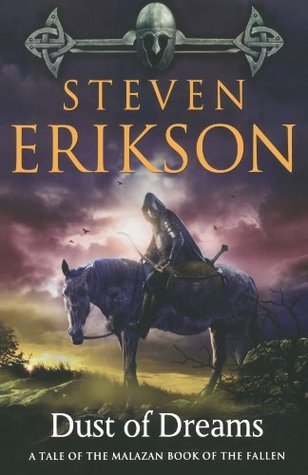
I have arrived at ‘Dust of Dreams’, installment number 9 of 10, and thus the penultimate book in ‘Malazan Book of the Fallen’ by Steven Erikson.
Or, perhaps rather than the penultimate book, it’s more of the opening part of the ULTIMATE book, with it being stated by the author to be the first half of the ending of the series, split into two novels: 1)’Dust of Dreams’, and 2)’The Crippled God’.
“Some roads, once set out upon, reveal no possible path but forward. Every other track is blocked by snarls of thorns, steaming fissures or rearing walls of stone. What waits at the far end of the forward path is unknown, and since knowledge itself may prove a curse, the best course is simply to place one foot in front of the other, and think not at all of fate or the cruel currents of destiny.”
Still reeling from the events in the climax of ‘Toll the Hounds’, my fear level for the fate of my favourite characters remaining alive was of course sky high. And with good reason. Many of them are components of the Bonehunters. And the Bonehunters – in addition to several different armies – are in the plains of Lether, moving towards the inevitable final conflict.
And Adjunct Tavore, leader of a rouge army, in preparation for that final conflict, commands subordinate Fiddler that a reading of the Deck of Dragons take place, and assigns Fiddler as the dealer.
These readings, when they happen in the series, are always highly significant moments the reader will want to pay attention to.
The Deck of Dragons is a deck of cards, portraying who comprises the pantheon of gods in the ‘Malazan’ universe, with the cards in the Deck standing for specific players within the High Houses of the Ascendant gods and their subordinates. The main High Houses in the Deck: Life, Death, Chains, Light, Dark, Shadow, War. There are also players in the Deck who are unaligned – wildcards – and some of these are the most dangerous, for the lack of affiliation, and their individual power.
“’There is a version of the Tiles, consisting of Houses, a kind of formal structure imposed on various forces at work in the universe. It is called the Deck of Dragons. Within his Deck, the House of Shadow is ruled, for the moment, not by the Tiste Edur who founded that realm, but by new entities. In the House, there is no King, no Queen as yet, and below the King of High House Shadow are sundry, uh, servants. Such roles find new faces every now and then. Mortal faces.’”
Gods make their plans, forge their alliances, plot their betrayal, and scheme how to use humans for their own ends, or alternately destroy the human race and remake the world, and all the while, humans and those allied with them mount their final resistance.
At this stage of the series, it is difficult to discuss events, what happens with specific character arcs, etc., without huge spoilers. So, with that in mind, in the area in my reviews where I nominally speak on characters, I’ll take some time to chat a bit about one of the features of the novel which made me titter with excitement: getting the perspectives from the foreboding and mysterious K’Chain Che’malle, and learning more about these utterly fascinating beings.
After seeing the undead version of these creatures, who caused so much havoc in ‘Memories of Ice’, and seeing them on a more in-depth level in ‘Reaper’s Gale’, my interest in the K’Chain Che’malle only grew.
Now, in ‘Dust of Dreams’, the reader is given some really intriguing insights into these creatures.
The K’Chain Che’malle, said to have once ruled over the formidable Jaghuts, are thought to be extinct by many of the characters, in the early installments of ‘Malazan Book of the Fallen’.
Once dominant, and one of the founding species in the ‘Malazan’ world, these great reptilian juggernauts left remnants behind of their seemingly advanced civilization in the form of weird machines, architectural ruins, and barrows. It is clear that the K’Chain Che’malle were extremely powerful, and far technologically ahead of humans. So far ahead, in fact, that it is implied the Elder Gods kept the K’Chain Che’malle away from humans until after the downfall of the lizard-beings civilization, lest they annihilate human-kind.
Instead of merely hearing about the K’Chain Che’malle referred to as some great race of the past, or even seeing how devastating they are in battle (and also their vulnerabilities) in ‘Dust of Dreams’, we are treated to – along with other mesmerizing aspects about them – some of their thoughts, motivations, and how what place they believe they have in the coming final battle. Fabulous!
One general statement about the characters I will make is: the soldiers in the novel, both Malazan and non-Malazan are in a true state of flux. Many of them are finding distractions, as they await the inevitable battle which many know they won’t survive. Plagued by lassitude, doubts, boredom, bickering, morbidly contemplating their own mortality, we also see many of them desperately reach out to each other, tentatively exploring relationships they’ve always wanted to broach – knowing time is short, and feeling they need to make the most of their remaining heartbeats on this earth. The banter, the silly or tender moments, focusing in on these characters, will doubtless only makes the demise of some of them more heart-wrenching, when they die.
As the series winds down, I clearly see that the thematic work Erikson has done in previous novels, and continues to do in ‘Dust of Dreams’, has really helped elevate this series for me, in addition to the characters, to mythical status among fantasy series.
Many of the themes in ‘Dust of Dreams’ that stand out swirl around the extinction of peoples. Erikson seems to ask some very compelling questions about this topic.
Does true cultural memory survive no matter what? Or does the essence of a culture disappear once the people die out or are obliterated, even if there are traces of that culture left, even if there are a few straggling survivors to carry on that culture in a limited way? Does a species require ‘enemies’ to fight, in order to define themselves, and give them a purpose, something united to fight for (i.e. via their victories or losses against said enemies)? What do you learn when your civilization is gone? Can you find new stories about yourself, or is it all tied to when your people were at their peak? Does the world mourn (if you were seen as benevolent, or a sophisticated culture whose disappearance robs something from the world) when your race is wiped from existence? Does it cheer (if you were hated/seen as oppressors)? Does it care at all?
This theme manifests, pervasively, in how children, as the precious means via which civilizations carry on, are spoken about in the novel.
“The beast that was civilisation ever faced forward, and in making its present world it devoured the world to come. It was an appalling truth that one’s own children could be so callously sacrificed to immediate comforts, yet this was so and it had always been so.”
With the sense of gloom, in that there may be no children left to provide a future, Erikson also focuses on how we treat children – our most important resource –TODAY is of the utmost importance.
“A child starved never grows tall or strong. A child unloved can never find love or give it when grown. A child that does not laugh will become someone who can find nothing in the world to laugh at. And a child hurt deeply enough will spend a lifetime trying to scab that wound – even as they ceaselessly pick at it… all the careless acts and indifferent, impatient gestures… as if they had no time for their own children… and all of that was simply passed on to the next generation, over and over again.”
The prose continues to be of the highest quality. As noted in my review for ‘Reaper’s Gale’, the closer to the doom of many of the remaining characters, the more Erikson gives the characters monologues about aforementioned themes, as per the example above.
The level of carnage in the final battle of the book is true Erikson – shocking, a gut-punch, with consequential deaths, and thrilling fight scenes that will leave the reader astonished. Erikson truly plays with the reader’s emotions, as you hold your breath to see if one of your beloved characters might just make it out alive. And, as previously noted, the book ends on a cliffhanger, where it is impossible to have complete confirmation of life or death for many of my favourite players.
The reading has been long, filled with many more highs than lows, and it has taken some adjustments on my part, to get through this magnificent series. But I am happy I have had to make those adjustments, because it has forced me to grow as a reader.
With the lack of hand-holding, being thrown neck-deep into such a vast world as ‘Malazan’, and it’s battles, political intrigue, divinities and constant ascending of mortals to divine status, numerous realms and species, just the sheer amount of names, places, kingdoms, alliances, histories are overwhelming. With no buildup, you have to get comfortable with not having a large amount of information going into many scenes, but trust me, the way Erikson trusts you as the reader, you will figure (most of it) out in time. You will need to put in some work.
Yet is all that work, and confusion worth it?
I can testify, at least for me, about to begin the final book, it definitely has been.
The wonder, the beauty, the heartbreak, the excitement, the depth of worldbuilding and story that includes hundreds and hundreds of characters, some gods, some ordinary people, and everything in between, will keep you coming back for more. If you are someone who loves epic fantasy, as I do, you will be profoundly affected by this series, and never regret the effort it took to read ‘Malazan’.
I certainly haven’t. As I approach the final book in the main series, I feel I’ve been part of something immensely unique, special, and unlike anything else I’ve read yet in the fantasy genre.
Onto the finale, ‘The Crippled God’!
Add ‘Dust of Dreams’ to Goodreads:
https://www.goodreads.com/book/show/4703427-dust-of-dreams
Author Photo


