

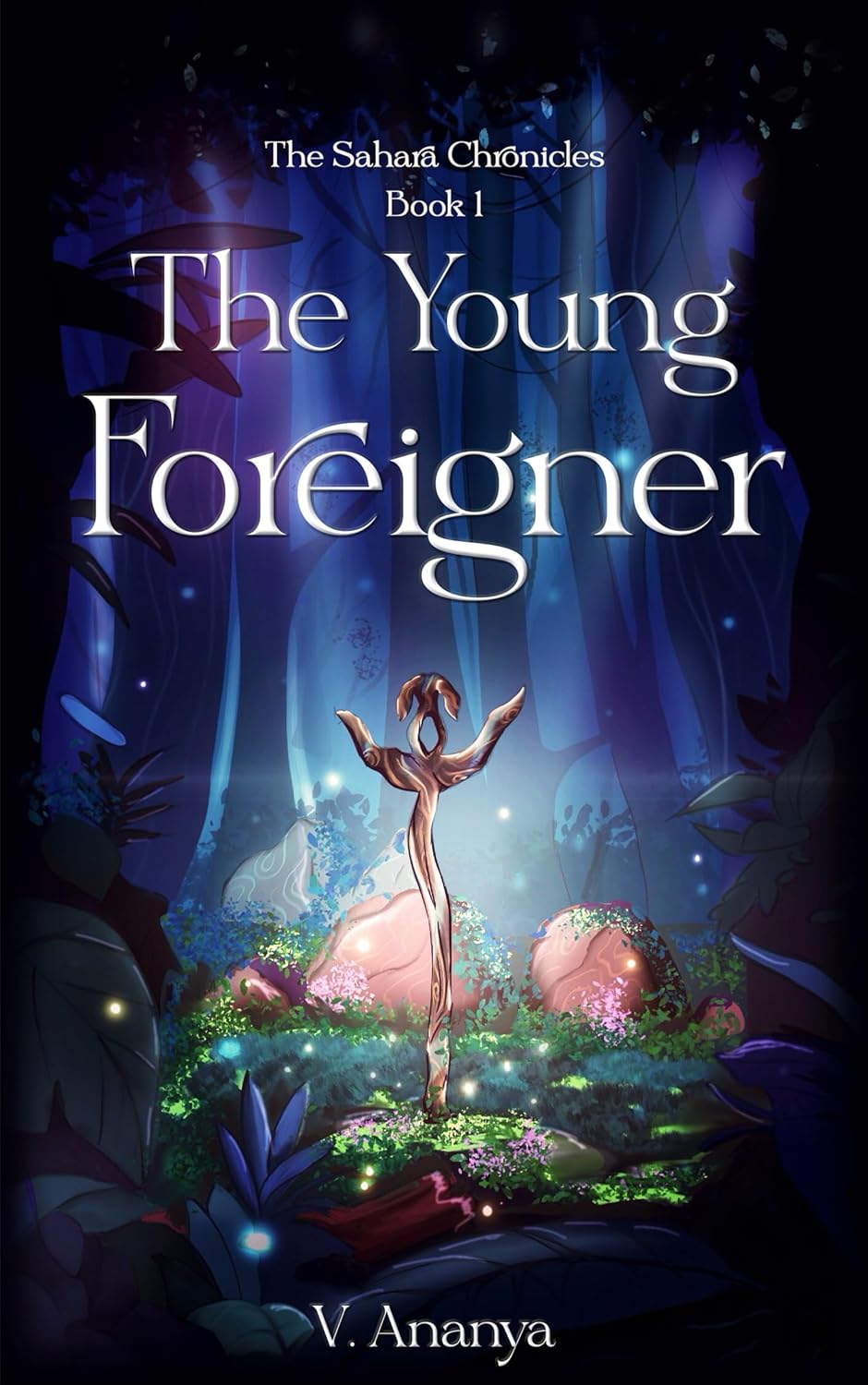
The Young Foreigner
by V. Ananya
“Somewhere in my vile heart
I knew I found my
The ones who’d put me to rest.”
A man seeking his fortune.
A woman driven from her own home.
Two legends lost in time and space, return to finish what they started.
One woman who dreams of her love.
One man who fights for a kingdom he lost.
Three prophecies to rule them all.
Who will win and who will lose?
Yor Castel is an alchemist in Sahara fresh out from under the wings of his wizard master and sets off on a journey around the world to seek the fortune calling out to him. With him is a gift from his a belt that contains the most important potions and a flute that can calm even the most disturbed creature.
Elmeida Yuri is the eldest daughter of the Dark Queen of Sahara and has just escaped the most gruesome incident of her life. She seeks shelter and comfort with the only person she her maternal aunt, Alia Hudson, who resides in a neighbouring country.
On the other end of the world, the Master of Darkness is rising, after having been asleep for centuries, and that begins a chain of processes unimaginable by mages of the present day. The Light and Dark wizards of yore awaken just in time to stop him, but now, it seems as if the enemy has grown even more powerful than the last time he had been engaged in battle. So, Yor and Elmeida team up and decide to help keep him at bay.
---
"The Young Foreigner" is the first in a fantasy adventure series, "The Sahara Chronicles".
This book is suitable for readers above 14 years of age.

SPFBOXI – Our Reviews
Steve Hugh Westenra
“ At once, such sweet music floated across the whole room . . .. As the notes of the music floated in the air from the instrument and surrounded her, dancing away, the invalid on the bed gradually stopped her movements and fell back into her slumber, looking every bit as relaxed as she felt. A small smile appeared on her face.”
V. Ananya’s The Young Foreigner is in many ways quite unconventional from the standpoint of modern fantasy. It has a little of the fabulous and the allegorical about it, reminding me most of all of Paul Coelho’s The Alchemist (which admittedly I read some time ago). Like Coelho’s Santiago, the titular young foreigner (called Yor), travels from place to place encountering unusual people. The language is simple and straightforward, yet the story itself has a dreamlike quality, perhaps due to Yor’s encounters with visions and dreams.
While there’s a subtle beauty to Ananya’s third omniscient writing, as well as to the story’s opening few chapters, as Yor’s adventures continue, the plot becomes increasingly convoluted. Yor’s encounter with a mysterious princess called Elmeida Yuri establishes Yor’s part in a larger, more complex set of political and magical events, yet it also signals a shift in the kind of story being told. Some of the worldbuilding and character names here feel a little detached from a deeper sense of meaning, and it becomes more challenging to remain invested as Yor and Elmeida’s conversations are overtaken by backstory and worldbuilding information. Major events are also often conveyed after the fact, with changes in Yor’s circumstances conveyed over the course of just a sentence or two. It makes for a roller coaster of a read in some ways, but it also adds quite a bit of distance between the reader and what’s happening on page. While this detached style works well in the novel’s opening sections, as The Young Foreigner‘s plot transitions to a more standard high fantasy storyline, it feels slightly out of place.
The pace of The Young Foreigner is very fast, and chapters more or less elide one into the other, with scenes often interrupted by chapter breaks only to be immediately continued. While this was certainly an unexpected choice, it didn’t bother me or hinder my reading, and for many may make the story more compulsively readable.
Although for the most part it’s a smooth read at the line level, the simple past is persistently used in place of the past perfect, which often pulled me out of the story as I was reading. It’s an easy enough fix, however, and an issue worth attending to to help with the readability of the story. There are occasional other errors, but nothing I couldn’t parse, and for someone invested in the larger story, these minor grammatical issues are likely worth pushing past.
I’d most recommend this one to fans of classics like Gulliver’s Travels, but also to the aforementioned The Alchemist, and young adult readers who don’t mind not having all the context for a world. As Vananya suggests in her own description of the story, it may also delight young adults (Vananya suggests readers 14 and over).


