

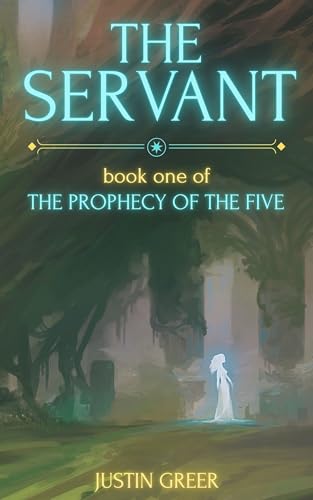
The Servant
by Justin Greer
Nearly a thousand years ago, the tyrant-sorcerer Mordechai betrayed his people, forged a weapon of darkness, and led an assault against the Middle Kingdoms to claim the throne of Reality. He slaughtered the defenders, broached the Shimmering Door, ascended to the Unseen Realm, and sought to make himself a god at the Heart of the World. Only at the last moment was he thwarted—by the sacrifice of a young woman, Lightbringer, who slew the Servant of Darkness and ended his terrible campaign.
But now evil stirs in ancient strongholds, and blood-rituals claim the lives of innocents throughout the cities of the world, and fearsome shadow-monsters have reappeared to feast upon the living. The Servant has been resurrected. His armies have grown. His power has swelled. And he has resumed his bloody war against the free world. Again he marches for the Shimmering Door and the Heart of the World; and now there are few who remain to stay his hand.
Only a young forest girl, Ashera Eldibara, has any hope of standing against Mordechai. She bears the Sword of Light, the fabled weapon of her predecessor, and its magic hums in her bones. Others stand at her side as protectors and guardians—a wizard, a warrior, and a huntress, each prepared to sacrifice all in the last desperate struggle against the Servant of Darkness.
But they are few, and Ashera is young and untrained, inexperienced in the ways of magic and warfare—and the monstrous armies that she faces are vast and powerful . . . and already hunting her.

SPFBOXI – Our Reviews
Steve Hugh Westenra
“She gazed out over the Silverfire Forest in quiet reflection, endlessly tracing the rhythms of the hills and valleys, the breath of the land, the movement of birds and trees and ploughed fields.”
I first read Justin Greer’s work in SFINCS 2, when his novella, Leafdust and Deadwood was assigned to our team as a semi-finalist. It was one of my personal favourites out of the batch and featured gorgeous pastoral prose and a real sense of intent. The Servant feels equally intentional in terms of what it’s aiming for, and though it’s a much grander and more action-packed story, quiet moments do slip in here and there that showcase Greer’s skill at portraying textured, believable landscapes. That said, while there was much that impressed me, ultimately The Servant retreads too much old ground and relies too much on archetype and formula to sustain a book of its length. Likely to appeal most to Wheel of Time fans and readers looking for fairly cut-and-dry stories of Good versus Evil (relayed as Light versus Darkness), Servant is a smooth read that showcases Greer’s huge potential while not entirely captivating me in the way I had hoped.
At its core, The Servant is about grand mythologies and warring forces that extend beyond the temporary struggles of the human world. Greer calls these forces Reality and Unreality, though more familiar stylings such of those of Light and Darkness also recur throughout the story. The book opens with a bang in its prologue, zooming in on a wizard named Kirin whose transportative, mystical vision of the past cuts him off from the very immediate threat posed by an attack by the forces of evil. The vision isn’t without import, however, and relates both to Kirin and the reader the details of an earlier cosmic struggle between the Champion of Light (called Lightbringer) and the titular Servant of Darkness. Kirin learns that a new Champion has awoken and that, though long-thought dead, the Servant is about to reemerge as a power in the world. It’s Kirin’s duty to locate, protect, and train this new Champion. The Champion herself is the true protagonist of The Servant. In the tradition of many such chosen one narratives, Ashera has seemingly humble origins. Her story begins in a community famed mainly for its mysterious forest–the rumoured home of fairies–and she lives a happy and ordinary life with her sister and the rest of her family. We spend some time getting to know Ashera and her surroundings for a few chapters before the Campbellian Call to Adventure takes hold, and after that the story turns toward the truly epic with Ashera and her mentors journeying across the land and thwarting evil as it threatens major cities and travelling peasants alike.
Greer’s prose throughout is accessible and not without beautiful moments. As in Leafdust, some of the strongest passages are those in which the author spares a moment to comment on the natural world, and I found myself really enjoying those times when it felt like Greer was letting himself be a little playful and indulgent. Sometimes when you’re reading a work, a particular line or moment will strike you and you feel a beautiful connection with the author through their storytelling or prose. Greer’s work certainly has those moments, ones where I sensed that something truly personal was coming through. While in Servant‘s opening chapters there were a few occasions when the past perfect ought to have been used in place of the simple past–a personal bugbear of mine–the writing is also exceptionally clean. Readers wary of self-published works due to a perception that they will be full of typos and other errors, may be reassured by The Servant.
Stylistically, I did find that the grandiosity and bombast of the more standard fantastical passages rang a little false and hollow, especially when compared with The Servant‘s more grounded moments. At about the midpoint of the novel, Tolkien’s influence on the work becomes very clear, but while Tolkien’s Middle-earth feels anchored in a rich context and is influenced by Tolkien’s personal and academic expertise, here the medievalism of the writing feels disconnected from any roots or specificity that would lend it a deeper meaning. Unfortunately, this style tends to flatten the ability of the narrative to really draw on its characters and their personal stories or voices–something that would otherwise elevate a Tolkienian-styled work beyond the imitative. Throughout Servant, Ashera suffers a number of tragedies and setbacks, but I have to admit that I never felt moved by them. On paper, Ashera is a likeable protagonist, but the distance and grand posturing of the tone made it challenging to suspend disbelief and convince myself that the emotions we are told she is feeling are genuinely felt. Much of the novel is taken up with lengthy discussions about, and reiterations of, the ways in which Darkness and Unreality are dangerous and opposed to Reality and Light. I’m certainly not against more philosophical musings in fantasy, but these felt surprisingly rote and interchangeable. That much of the worldbuilding is relayed to Ashera and the reader through lengthy lectures by her mentors also slows down the pacing and gives the impression that the story is more interested in lore than in worldbuilding.* This is possibly the first review in which someone has ever argued for more feast scenes, but some of the strongest character work in Servant comes through during tender moments shared between Ashera and her companions, in which they chat about mundane matters like regional foods or particular cravings. If these quiet interludes had been balanced out more and less time had been spent telling the reader what was happening (and had happened, and was going to happen), this would be a much stronger book and would stand a good chance, I think, of standing out from other Campbellian fantasies.
There are some impressive action sequences that clued me in to how skilled Greer is at combat scenes. Somewhat paradoxically, it’s very hard to make fight scenes feel genuinely tense, yet even in a story in which the outcomes are structurally somewhat predetermined, Greer’s talent stands out. Certain events at the novel’s conclusion have a roller coaster feel that will certainly appeal to a lot of readers.
At its best, The Servant features resonant prose that speaks to an understanding of the connectedness between landscape and mood. Although The Servant is flawed, there’s a huge market–especially in our current historical moment–for fantasies in which the good guys are easy to identify and the bad guys are capital “ee” Evil. If you’re a reader who longs for this kind of work, Greer’s a solid prose writer and worth checking out.
* That one of the more nefarious nations in the book was subtly Muslim-coded (I expect unintentionally, as an important note), also troubled me, and is an all-too common feature of much of this type of fantasy.


