

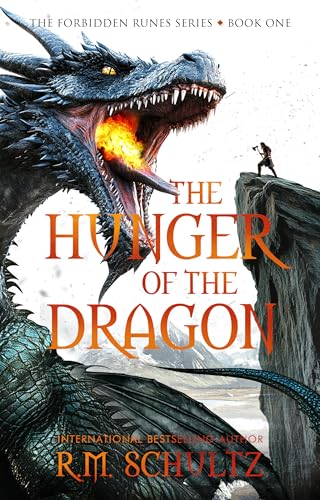
The Hunger of the Dragon
by R. M. Schultz
“My Norse-obsessed friend wouldn’t stop raving about this book, so I had to read it.
– Loved it.”
“If The Bloodsworn and Jade City had an offspring that inherited the best qualities of both parents, this book may be it.”
“This book has the most interesting take on Norse magic and lore that I’ve read yet.”
“It’s Norse fantasy that sinks its teeth deep and does not let go.”
Divine remnants are hoarded, stolen, and killed for.
These items grant powerful magics to those with the strength to wield them.
The war of the gods has passed, leaving Midgard without direction, but vengeance and the battle for control has just begun.
A berserker of the Raven must protect her magical items from those bent on stealing them while a Wolf warrior renounces her clan to pursue the impossible—harnessing the magics of the Dragon. A thief of the Wolf is led astray and will never regain what is taken from him. They protect their own, claim what they can, and rise to power in waves of glory.
But when a mysterious new clan emerges seeking to conquer all, the Ravens and Wolves must safeguard their divine remains or destroy each other.
The resulting war will determine the fate of each clan as they succumb to the hunger of the Dragon and the forbidden runes.

SPFBOXI – Our Reviews
Catherine Catcho
(lookma.i.read)
“Confidence can shatter fear, but arrogance will get you killed.”
Quick Pitch:
Gritty high fantasy- where everything is going to get a lot worse before it gets any better. Multi-POV’s, multiple injustices and tragedies between the animal communities. But give me some hopeful (and maybe impossible) Norse lore and we have ourselves an adventure.
Overall Thoughts:
It took me longer than I hoped to get in the flow of all the moving parts.
I thought the talking voices was an interesting use of magic, but I felt exhausted for the FMC dealing with it.
I liked the artwork in this!
Noel Cober
“This world left to us by the gods isn’t meant for you and me.” Märren pulled her daughter close, squeezing her. “We are different. Most don’t see things the way we do.”
Hunger of the Dragon is a dark Viking fantasy told across three perspectives as warriors from two clans try to survive and fight off the growing threat of a new clan in a world where the gods are dead and humans fight over—and with—their remains.
If that sounds cool, it’s because it is. There’s a lot of cool and interesting worldbuilding in Hunger of the Dragon, and the spaces the characters navigate are richly drawn and evoke the feeling of the Viking world really effectively. The world also feels very original. My beef with a lot “[real historical culture]-inspired fantasy” books is that the real historical culture can sometimes overwhelm the fantastical element. It feels like R. M. Schultz has done a good combination of research but also meaningful worldbuilding to put this book together and I like that a lot.
I also really like the multiple perspectives we get in this book. I love multi-PoV epics with really different characters navigating complicated situations, and that’s what Hunger of the Dragon delivers, moving between three characters whose motivations are overlapping but not always identical, though of course they do solidify as the book goes on and they become more wrapped up in their conflicts with the sinister Spider Clan. I will say that though the three characters are different, they all do come from similar warrior backgrounds, which is expected in a Viking fantasy but I did kind of wish I could have seen the perspective of someone who wasn’t a berserker. That said, I really like that two of the three PoV characters are women. There’s specific dialogue early in the book about how the misogyny of the Viking past is over and nobody has any objection to women being warriors now, which is great and much needed in this genre. The female characters are very distinct from each other and have their own motivations and goals that feel distinct and sharp to me.
I do unfortunately find that not all the PoV characters in this book are created equal. The first character we’re introduced to, Märren, is on a quest with the skull of her dead daughter and the triad of strange voices that lives in her head (and later a weird spirit creature who I quite liked), and though she kicks off the story, I found her very disconnected from it for the most part, and the things she’s doing, though they obviously have long-term connections to the rest of the story, feel like they aren’t really part of the same conflict the other characters are dealing with. I also found her chapters the hardest to read; they tend to be very exposition heavy and the voices in her head offer a chorus-like commentary on what’s happening, which sounds cool but often ends up just being extra exposition. Issues like this do exist in the other chapters as well, but it’s in Märren’s that I had the hardest time with. I will say that later chapters do get better on this front (the book generally improves significantly once it’s past the first fifteen percent or so), but personally I never quite got to the point where I enjoyed seeing one of Märren’s chapters appear. Of the other two characters, Caëtin is definitely my favourite; I found her voice and her internal conflicts very interesting, and her relationships with her dysfunctional family were really compelling (plus the fact that she can turn into an unkindness of ravens is very cool). The third character, Belfedrn, was fun as well, though I felt through parts of the middle like his arc was a bit aimless until he got back on track near the end.
The characters in this book all feel very connected to the world, which is great, but ultimately I found that for most of the book, they don’t always feel connected to the same world. They’re clearly dealing with the same overall issues, but for large parts of Hunger of the Dragon I felt like I was reading three different books all set in the same world, rather than one book. That is something else that does improve as the book goes on, but it did impact my reading of the first half and a bit of the book.
Overall, I liked Hunger of the Dragon; I found it compelling and fun and the ending made me want to read the sequel. It’s not perfect and the opening chapters especially do not do justice to the rest of the book, but I do think it has or will have a very enthusiastic audience in fans of Viking fantasy and I really hope that audience gives it a try!


