

“I could feel the tension at the edges of my face, the discomfort where my body met the world.”
Nour Abi-Nakhoul’s Supplication is all aftermath.
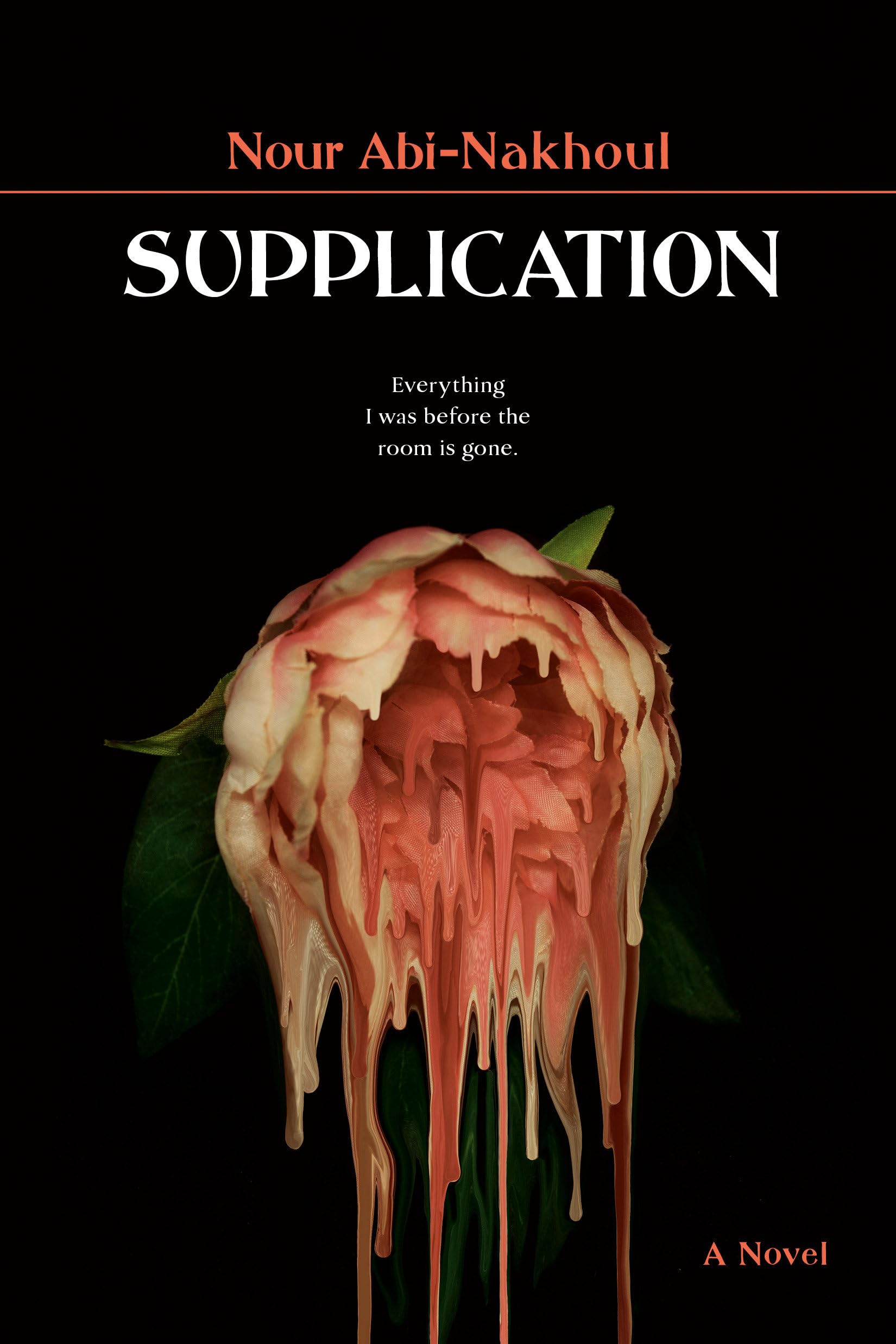
A surrealist, stream of consciousness literary horror, the prose drips and melts just as thickly as the flower on its cover. It’s a work entirely itself that’s challenging to describe–so much about what makes it unique lies in its amorphousness, its indescribability. As stated above, however, the one word I keep returning to is “aftermath.” Aftermath, that is, and metaphor, for Abi-Nakhoul’s exploration of language, texture, and examination of event through metaphor are, it seems to me, essential ingredients in the recipe that makes up Supplication.
We open on a woman in a room. She’s been kidnapped and mutilated and her only escape lies in radical acceptance of her  current situation. Against expectation, she leans into and takes on the desires of her tormentor, attuning her brain to his perverse wants and intentionally investing herself more deeply in his violent fantasies so that they appear to become her own. Fortunately, our progtagonist is able to escape, but what follows that escape is a nightmarish fever dream that causes us to question just how possible escape is when one has suffered violence. Supplication isn’t a novel it feels possible to spoil in the sense that the work is more of an experience than a traditional story. The event that precipitates the rest of the novel is the most concrete element in Supplication, and even there we’re on unsteady ground. Occasional, precise, clotted moments bob about in a sea of the protagonist’s trauma: a mysterious worm, tentacle, or protrusion slinks inside the protagonist and juts out at later moments; the protagonist kidnaps and murders a couple; the protagonist decapitates a gas station clerk; rides a taxi to a doctor’s appointment; fixates on the innocence of a horse in a field (that may symbolize her own innocence). One of the most powerful scenes in Supplication was, for me, a moment of retraumatization (though arguably, the book never leaves the moment of trauma–that’s the point!) when she spots her attacker walking hand in hand with his daughter. The recognition that this man has a life apart from what was done to the protagonist feels more violent, even, than the attack and kidnapping themselves. The very fact of his ability to live apart from and outside the protagonist’s suffering is an affecting and effective rendering of the experience of abuse and how it’s felt and treated by abused and abuser in many cases.
There’s an oozing, melting quality to the prose and the story throughout, one that feels intrinsic to Supplication‘s thesis. The story isn’t told so much as felt, embodied in every sentence individually as well as in the shape of the book itself. What exactly is happening on page is often opaque, but it’s an intentional opacity that forces both us and the protagonist to question the truth of what we’re reading. Or, perhaps more accurately, it forces us to question the ways in which truth is to be defined. The language Abi-Nakhoul employs is slippery in a way that fits this constant uneasiness and uprootedness. One theme that’s introduced early and that is explored in new ways throughout is the sense of the protagonist (and all of us with her) as being actors within the dramas of other people. At various points the protagonist describes herself along these lines, or as feeling a sense of the “story” unspooling around her. She’s not an actant in her own narrative, but a player in other people’s. This dissociation reinforces the feeling one gets while reading that much of what she describes herself doing is metaphorical rather than actual (or, at the least, imagined). Perhaps she doesn’t inflict literal, physical violence, for example, but rather her trauma rises up and inflicts emotional violences on those she encounters.
“The woman hadn’t been prepared to become something else, so she hadn’t become anything. There was nothing left there, there was no name that could be used for what was lying there pathetically on the floor; I didn’t have a name for it.”
Supplication isn’t a book I’ll soon (if ever) forget. I’d recommend it to literary readers who aren’t afraid of venturing into some dark psychological spaces, as well as readers of stream of consciousness fiction. It’s a book to provoke discussion, and what I wouldn’t give to be a fly on the wall of a bookclub that picked this one up.
Purchase Supplication from Indiebound.
Add Supplication on Goodreads.


