

A year of books that refuse to be simplified
Like many onlookers in the wake of Trump’s election last year, I’ve consistently wrestled with feelings of despair and doom. As a writer, a cultural studies scholar/historian, and a trans person, one of my immediate concerns in late 2024 was censorship (it still is a concern, though the constant barrage of ongoing crises means it’s not always at the top). Still, the myriad troubles of our troubling times are hopelessly intertwined, with censorship of specific viewpoints, voices, and positionalities intended to limit our ability to communicate with one another and to express ourselves. When TikTok and Meta-owned applications silence the voices of those documenting ongoing atrocities in Palestine, Minnesota, behind the doors of concentration camps, and across the world, our ability to inform one another and organize is at risk, as is the capacity for the public to grasp the breadth and significance of what’s going on.
At a micro level, and in part due to my own positionality as a trans author and critic, my personal anxieties often involve the silencing of trans voices. The censorship of erotica on Itchio and Steam, thanks to the cowardice and complicity of credit card companies and payment processors, hit trans authors, visual artists, and game designers particularly hard. Beyond the censorship of trans works, queer and contrary  voices like those of horror author T. C. Parker are quietly muzzled, as recently occurred when her book, Tradwife, was removed from Amazon with the excuse that its very mild cover was gory and grotesque. The reality is that much of the time, censorship efforts are not loud, dramatic affairs, but are covert endeavors that shield themselves behind a reasoning that is more palatable to the general public, or involves invisible choices on the part of individuals (librarians “losing” books, auto-rejecting authors from slushpiles, or measuring marginalized voices against harsher criteria). Cries to, “protect the children” have a long history of being wielded to foment prejudice against marginalized people (especially queer people, racialized people, and religious minorities). When these tactics are wielded against marginalized authors in indie spaces, censorship generally faces less push back, and since trans and gender diverse authors already face an uphill battle breaking into traditional publishing, many of us depend on our ability to independently publish, or publish with niche presses, in order to circulate our art.
It was thus already a personal goal of mine to read more books by trans, nonbinary, two-spirit, and gender diverse authors. Too often, we each silo ourselves to only certain kinds of authors (those who look like us, think like us, are from similar places, prefer certain genres, or who write according to mainstream dictates of what marginalized art is supposed to look like). I wanted to deepen my knowledge and appreciation of what trans authors and artists are doing, and in line with The Transfeminine Review’s brilliant article on combating censorship under facism, I also wanted to make an effort to help preserve our literatures.
The Trans Reading Group (as well as an archival project a librarian and artist colleague and I are still seeking funding for) was born from the need to promote, share, and salvage the diversity of trans and gender diverse writing being created. Throughout 2025 and now into 2026, I’ve run an in-person book club that reads works by trans and gender diverse authors.* Each month, we’ve read a minimum of one book by a trans, two-spirit, nonbinary, or gender nonconforming author,** and the quality of conversation around these works has consistently impressed me. This year, we have several new readers joining us, both from within the community itself, and from outside it.
Participating in the group has truly broadened my horizons. The books we read include fiction, memoir, poetry, essay and short story collections, traditionally published books, self-published books, small press books, works by authors living and dead and whose voices only survive thanks to the ongoing efforts of very small publishers and passionate communities. I’ve also read outside the official reading list, and every book I’ve encountered has enriched my understanding of what trans and gender nonconforming artists are capable of and are interested in.
Common themes and concerns of course crop up in trans-authored texts, and that’s particularly true when you narrow your focus to specific genres and subgenres. As a horror fan and author, I tend to read more deeply and widely in those categories, and it would be negligent not to comment on the ways in which horror (and especially body horror) is uniquely positioned to express and explore common trans experiences like dysphoria, dysmorphia, and the perils of (in)visibility. Nonetheless, trans work can’t be limited to these themes, and one of the reasons why I’ve wanted to expand my trans/gnc reading has been that so often the stories by trans/gnc people that are championed by the mainstream privilege themes and motifs that appeal to cis audiences. There’s a prurient interest in trans vulnerability, violence, and the body that often seems to undergird cis interest, and we can see this in the overrepresentation of the nonfiction trans memoir compared to other forms of trans stories. So often it can feel like cis interest in trans authors and our stories begins and ends at an interest in what resides beneath our skirts or inside our pants. Of course, stories about these things (including memoir) are extremely valuable, but if I were to successfully convey one thing about trans literature to cis readers, authors, and critics, it would be that supporting trans literature means supporting our ability to publish with the same freedom of theme and subject matter that cis authors enjoy.
The following is a series of micro-reviews and introductions to everything I’ve read over the past year from trans and gender nonconforming  authors. If you’ve never read a book by a trans or gender nonconforming author before, I recommend browsing the list to see if anything strikes your fancy. If you typically read fantasy, maybe dip into some literary fiction. If you only read traditionally published books, try something from a self-published writer.
This is, of course, a limited list, so I also recommend browsing some of the lists of trans works I’ve collected on Pagebound (a Goodreads alternative). I’ve only started two lists so far, for speculative fiction by trans and gender nonconforming authors and for horror written by trans and gender nonconforming authors, but I hope to create more! If you have your own recommendations for books, please do comment below with suggestions, comment on the lists themselves, or share your recommendations in real life or on social media. Spreading the word about books you love has such a huge impact.
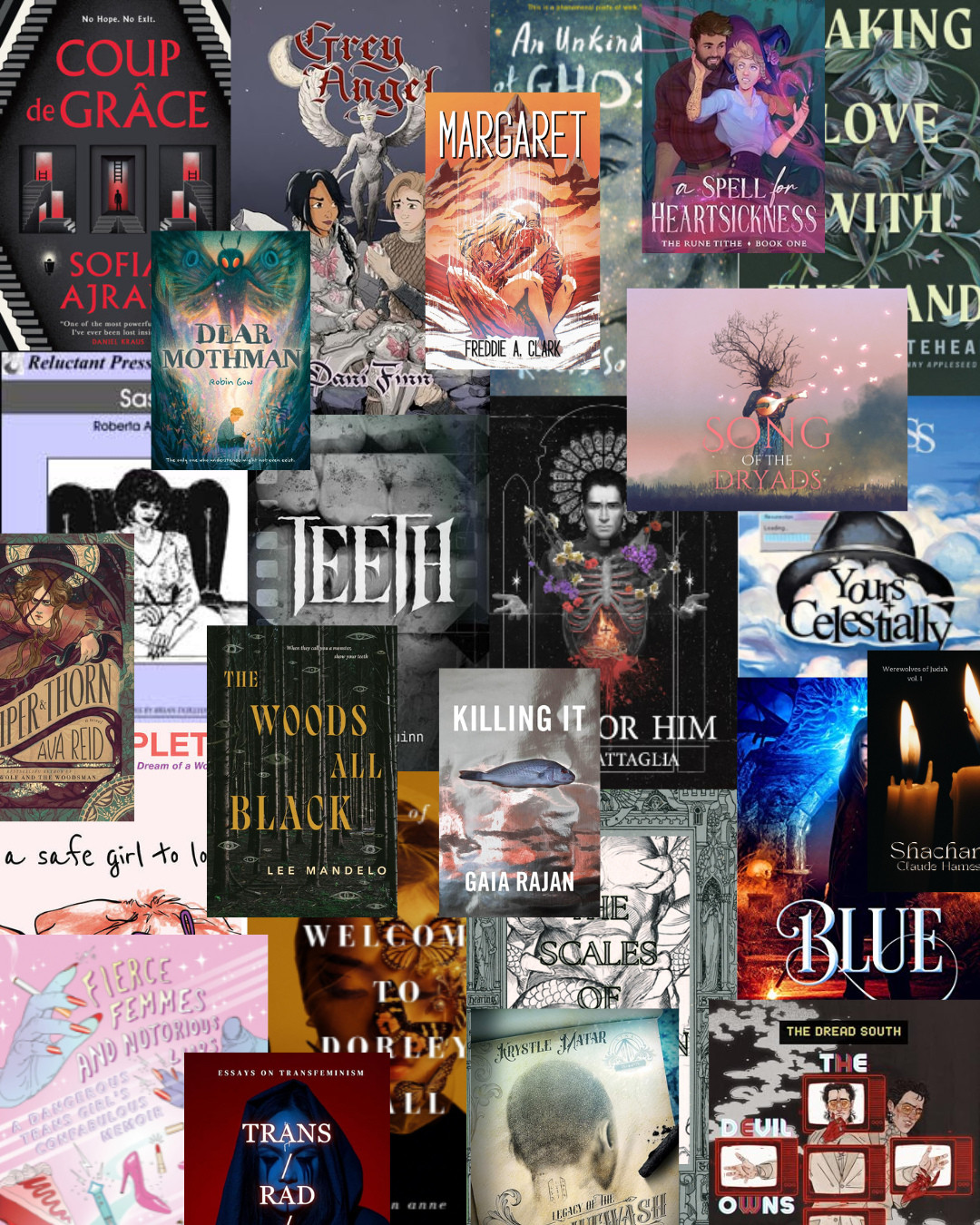
I’d also like to share the list of books the Trans Reading Group will be reading in 2026 (pictured in the graphic above alongside books from my personal TBR pile). If you’re interested in reading and chatting about any of these, please don’t hesitate to grab them. If you’d like to join the group, just reach out to me on Bluesky (@stevewestenra).
Trans Book Group 2026 Reading List
January: Fierce Femmes and Notorious Liars – Kai Cheng Thom
February: Desecrated Poppies – Yaffa
March: They of the West – Dani Finn
April: Look Who’s Morphing – Tom Cho
May: Stag Dance – Torrey Peters
June: Kiss of the Fur Queen – Tomson Highway
July: The Year of Blue Water – Yanyi
August: The Cosmic Colour – T. T. Madden
September: Dead Cowpokes Don’t Wrangle – mars adler and H. S. Wolfe (eds.)
October: The Home – Judith Sonnett
November: The Fealty of Monsters – Ladz
December: The Library Thief – Kuchenga Shenje
The Books
A Safe Girl to Love – Casey Plett

Casey Plett’s A Safe Girl to Love is a collection of captivating, heartbreaking, and fundamentally honest short stories that explore the lives of different trans women. There’s a small amount of intersection between the stories, with central characters from one story appearing in the background of others, and some characters and locations reappear in her follow-up collection, A Dream of Woman.
So many of the experiences Plett articulates here (especially around dysphoria) really resonated with me, though I myself am a trans man, but there’s a particularity to them as well in terms of how they engage and portray transfeminine experiences, desires, and anxieties. I couldn’t stop reading this one once I’d started. I could have spent a full novel with any one of Plett’s characters.
For those not familiar, Plett is a titan of the trans literary scene. If you’re just getting into trans literature, she’s an excellent gateway!
The Devil Owns Primetime – Sirius .

A horror novella that doesn’t skimp on the gory, erotic, or emotionally-raw details, Sirius .’s The Devil Owns Primetime was a real gem from my SFINCS competition allotment. I was blown away by Sirius .’s skill, especially in terms of character voice and sense of mood/theme.
Devil focuses on a successful (if morally bankrupt) Southern televangelist, whose wealth and fame are the result of a Faustian bargain with the devil. When the devil returns to collect, the few genuine emotional connections the protagonist has are stretched to their limits, and the emotional wreckage left in the protagonist’s wake is truly gut-churning.
If, like me, you love an off-kilter, thorny, and morally suspect protagonist, I highly recommend this one. Sirius .’s approach is nuanced and specific, and they’re a unique voice not only in trans horror, but in horror more broadly. They deserve to be so much better known than they are.
Song of the Dryads – Bailey Saxon

Like Devil, Song was one of my SFINCS competition allocations. Nearly the polar opposite of Devil, Bailey Saxon’s Song of the Dryads is all about self-affirmation and the ability of friendship and community to help us overcome self-doubt and adversity.
There’s a coziness to Song that opens it up to a wider potential readership. Set in a secondary fantasy world, Song follows Bianca, a Black trans woman who only awakens to her gender identity following her death. The novella is the story of Bianca finding herself alongside a found family of fantastical creatures, and the whole work has a coming-of-age feel, but in an adult context. Humour and melancholy are well-balanced here and I loved the chapters from Bianca’s grieving sister.
Saxon’s passion in this one drips from the page, and if you love protagonists who are a delight to root for along with banter and found family dynamics that support themes of self-realization, then this is one to check out!
Coup de Grâce – Sofia Ajram

This one was a reread for me, and I’m happy to say it absolutely holds up. One of my favourite books of 2023, it’s a visceral yet lyrical exploration of suicidal ideation,depression, and self-harm. It’s incredibly dark and won’t be for everyone, but it was absolutely for me.
Coup has a great hook: Vicken, a suicidal young man living in Montreal, buys a metro ticket with the intention of wading into the Saint Laurent river. Rather than reaching his destination he finds himself trapped in a labyrinth of endless metro tunnels and stations. The voice in this one is razor sharp and Vicken’s emotions really carry the novella. Despite (or, perhaps, intensifying) the dark subject matter, there are some very fun, snappy, experimental chapters to the book that I particularly enjoyed and that add layers of nuance to the work.
Teeth – S oraya E. Quinn
 oraya E. Quinn
This one’s on my list to fully review in the next couple of weeks (hopefully this week!). A horror comedy novelette with strong erotic elements, this one is for fellow were-creature fans. The protagonist of Teeth, Lex, suffers from Premenstrual Dysphoric Disorder (PMDD), which in the world she inhabits involves transformation into a ravenous monster and has resulted in the deaths of multiple support group chairpeople (as a support group chairperson, I should probably watch out!).
This one’s funny, quirky, gory, and even a little romantic, but what’s most impressive about it is the incisive way Quinn achieves all that while still treating the story’s subject matter and themes with a needed weightiness. I cackled aloud reading this one, which is just about the best compliment I can give a comedy, and it’s left me slathering at the jaws for a sequel. Quinn is an author who understands that camp and horror go hand in hand, and who wields that knowledge exceptionally well when it comes to tonal balance.
Welcome to Dorley Hall – Alyson Greaves
I actually have a partial review of this one sitting in my personal dustbin of partial reviews, but it’s been there so long I may not go back to it. None of that’s a ding against Dorley, which is an excellent book and one of my favourites from last year.
Dorley Hall is a page-turner of a thriller that had me on the edge of my seat. It builds on the popular force femme subgenre, but takes its premise much more seriously than you typically find. It follows a closeted young trans woman who discovers that one of her university sororities is forcibly transitioning delinquent male students in order to combat their violence and misogyny. Since transition is unaffordable for her, she cons her way inside as a fake prisoner.
One of my favourite aspects of this book was actually how differently it reads depending on one’s positionality. While several of the transfemme readers in our group read aspects of it through a positive lens of wish fulfillment and a celebration of girlhood, as a transmasc reader the forced feminization of the imprisoned characters was a fascinating combination of horror story (reflecting experiences of what feels like forced feminization from a trans masc perspective), and a sweet story of friendship and mutual care. Whatever baggage you come to the table with, it’s a roller-coaster of a book with some fantastic character work.
Juniper and Thorn – Ava Reid

Full of Gothic texture and set pieces, this dark romantasy retelling goes hard when it comes to its explorations of abuse, racism, and xenophobia. Alongside the gloomy vibes, rich aesthetic, and challenging subject matter however, there’s also a lightness and sweet innocence to the romantic elements that means this secondary world urban fantasy will appeal to a wider audience. Saying that feels ridiculous given that Reid is already a juggernaut in both the YA and adult fantasy markets, but in case you’re not already familiar with her, she’s a nonbinary author known for her texture and lyrical prose and her deft hand when it comes to Gothic romance.
Juniper and Thorn is my favourite of Reid’s that I’ve read. It’s fast-paced but detailed, and her heroes are beautifully flawed. A retelling of The Juniper Tree, the novel follows a witch named Marlinchen, who’s essentially a prisoner inside her father’s home. When she escapes one day with her sisters to attend a ballet performance, she falls in love with the star ballerino. Compelled to visit him again, Marlinchen begins pushing back against her father’s abuse. I’ll leave it there to avoid spoilers, but it’s one I recommend!
Grey Angel – Dani Finn

Grey Angel is a secondary world fantasy novella with an epic feel but a tight focus. When I read it, I remember feeling shocked it hadn’t picked up more of an audience, with its crisp writing, deft approach to character, and a lively adventure/quest fantasy feel.
Finn is known for their imaginative fantasy worlds, species, and erotica. Grey Angel does include those elements, yet I can’t emphasize enough how much it really is a character piece at its heart. For those nervous about erotica, I should also mention that while this one does include sex scenes, they’re relatively few.
I feel like this is a great introduction to Finn’s work for general fantasy fans.
Its focus is on two trans soldiers tasked with killing the monsters that trouble the land. One of the characters is religiously devoted to the titular Grey Angel–a goddess of mysterious provenance who shares a connection with the monsters the soldiers are hunting. At its core, it’s a story about finding yourself and growing into your confidence, and Finn’s approach is nuanced and smart.
This was, rather shockingly, my first Dani Finn, but it definitely won’t be my last and I fortunately have a solid stockpile of their work to devour.
The Scales of Seduction – Rien Gray

Like Finn, Greaves, and Sirius ., Rien Gray is a titan of the trans indie scene. The exquisite prose on display in Scales will make it fully apparent why, and it’s rocketed them to the top of my list of trans and nonbinary authors to watch.
Gray is known for exploring a variety of genres, including fantasy, romance, mystery, and erotica. Scales itself is a work of historical/fantastical erotica about one of the last Basilisks and her romance with the gorgon Medusa. Full of lush writing, deep character work, and some beautiful meditations on monstrosity, transition, and identity, Scales is a monsterfucker novella I’d recommend even the erotica-averse try out, if only to marvel at Gray’s command of the written word.
(Horny) fans of Greek myth retellings, the Hades franchise, lesbian erotica, and stories about coming to love the strangeness of the bodies we inhabit will likely adore this one.
Trans/Rad/Fem – Talia Bhatt

Trans/Rad/Fem is the first work of nonfiction on this list and comprises a series of short essays that were originally published on author Talia Bhatt’s website. I initially read it in preparation for a podcast a friend and I are planning that will review trans books, but that we’ve unfortunately not got round to recording yet!
If you’re already part of the trans book scene, you’ve likely encountered Bhatt’s work before and she’s a hugely popular thinker and author. Best read and enjoyed as a kind of personal manifesto, it ferociously describes many of Bhatt’s (very justified) frustrations with transmisogyny, and revisits radical feminism in an effort to explore its validity and utility for trans women and trans femmes. I was particularly taken with her reevaluation of how the whole concept of the hijra is treated in the West, and after finishing the collection I was eager to read Bhatt’s (then) upcoming work on gender in an Indian context.
If you enjoy popular, critical opinion pieces and want to engage more with what trans thinkers are talking about outside an academic context, I recommend this one, as it’s been quite influential within online trans circles.
Yours Celestially – Al Hess

Al Hess is probably best known for his speculative comedy, Key Lime Sky (which I’m incredibly excited to read!), but Yours Celestially was my first work by him. A science-romantasy set in a near(ish?) future, it concerns a world in which a digital afterlife allows for the dead to download into new (and often idealized) bodies. Those who’ve spent time in the digital world often find themselves haunted by the voice of an AI known as Metatron, who may be more than his programming suggests. When a mutual affection develops between Metatron and a revived man named Sasha, it threatens to upend their assumptions about their worlds.
For all that Your Celestially tackles some rich (and dark) subject matter–abuse, racism, mortality–it’s ultimately a beautiful and uplifting book full of romance and banter. The world Hess crafts is fun and unusual, enriched by the aesthetic of the book’s artwork and cover (designed by Hess himself), and full of the potential for further stories.
It would be remiss of me not to mention that this one’s also a past SPSFC finalist! Well worth a look for those who enjoy speculative fiction that combines comedy and romance with serious themes.
The Woods All Black – Lee Mandelo

One of the biggest traditionally published trans authors writing today, Lee Mandelo is probably one of the more recognizable names on this list! An acclaimed horror author, Mandelo brings a visceral and vicious lens to his exploration of trans and nonbinary identities.
The Woods All Black is a historical horror novel set in rural Appalachia in the 1920s, and follows a former field nurse named Les as he navigates bigotry, ignorance, and his own growing romantic feelings for local trans man and delinquent, Stevie.
For all that Woods is a short read, it packs a punch, and is a deliberate call on the part of the author for trans people to “show your teeth,” as per the novella’s front copy. This one revels in its monsterfuckery, it’s full of rich description, Southern Gothic atmosphere, and violent catharsis.
Sasha – Roberta Angela Dee
 Sasha – Roberta Angela Dee
One of the more obscure books I read last year was Roberta Angela Dee’s Sasha. It was also one of the most fascinating.
Presented as a collection of letters between two trans women who become pen pals (one soliciting advice from the other), it blends aspects of fiction and nonfiction, as well as social commentary. Dee was herself a very active and influential member of the Black trans femme community both in the States and online during 90s and early 2000s. An activist and critic of the medicalization of trans identities by quack psychologists like Ray Blanchard, her fiction feels very rooted in that context.
Sasha itself is such a puzzle of a book and one that absolutely deserves to be analyzed academically. Its protagonist shares her name with the author, yet many of the viewpoints she espouses seem to directly contradict Dee’s own. The identity of the trans woman soliciting advice is presented within the narrative as a mystery in and of itself, each of these layers making Sasha absolutely compulsive as a read.
You can only find Sasha at Reluctant Press and I highly recommend grabbing it either as an eBook or paperback.
Legacy of the Brightwash – Krystle Matar
Krystle Matar’s Legacy of the Brightwash is very well known in indie fantasy circles, but is possibly less well known in trans and nonbinary ones. It’s a shame, because  it’s an excellent gaslamp fantasy that feels perfect for queer readers who don’t necessarily always want queer identity to be front and centre in the stories they read. Matar’s writing is smooth and accessible, and the historical texture of the work makes it a possible jumping-on point for fans of historical fiction who’re nervous about fantasy.
Although Brightwash isn’t about queer identity in the ways most readers would expect, it is about marginalization. Set in a brutal world in which those gifted with magic are imprisoned or otherwise controlled by the State, it follows a former military officer and current police officer (Tashué) as he investigates the murder of a young girl. What he uncovers soon has him questioning his loyalty to the regime he’s served all his life.
There’s something for everyone in Brightwash, whether you’re a fan of romance, mystery, or action. I found the mystery of the murder and of the sinister medical/psychological institution that looms over Tashué’s city to be the most compelling, and Brightwash is a page-turner.
Dear Mothman – Robin Gow

Robin Gow’s Dear Mothman is unfortunately the only Middle Grade novel on the list, but boy does it hit hard! The story of a trans pre-teen who’s just lost his best friend (and fellow trans boy) in a car accident, this one is guaranteed to tug on the heart strings. Told in verse, Dear Mothman is a fast read, but the gorgeous writing will have you eager to savour every word.
Its premise is compelling: after Noah’s friend Lewis’s death, Noah is drawn to the cryptid Mothman due to Lewis’s obsession with the creature. The majority of the novel consists of Noah’s letters to Mothman, which describe not only Noah’s attempts to prove Mothman’s existence, but also his own experiences of grief, alienation, and friendship. Noah feels a deep kinship with the cryptid due to their shared status as creatures no one seems to believe in, and Gow uses Dear Mothman to express meaningful observations to do with trans visibility and legibility.
A great book no matter your age, but I imagine it’ll be especially impactful for young readers dealing with loss as well as identity.
A Spell for Heartsickness – Alistair Reeves
I was so excited to get to read (and own!) a finished copy of Reeves’s enchanting romantasy, A Spell for Heartsickness. Reeves and I were introduced via our mutual  mentor, Mary Ann Marlowe, as we shared some common experiences and Mary Ann thought we’d enjoy each other’s work.
A Spell for Heartsickness has carved out a passionate following in the trans and queer fantasy community, and with good reason. It’s a heartfelt book that doesn’t skimp on the romance, while also dealing with some intense social issues. The novel follows a witch and fashion designer named Briar as he’s stationed in a remote, cursed village. The village isn’t all that’s cursed–Briar is all the more eager to make a name for himself and get his work out there due to a terminal illness inherited from his late mother. When the fashion and magic icon he’s looked up to his entire life (and who happens to be a powerful healer with Christ-like abilities), joins him in the village, Briar is torn between his attraction to his idol and a developing romance with a sweet local pub owner.
One of my favourite aspects of Spell was how well Reeves writes sex. I’m not really one for erotica (I absolutely value it, but most of the time it doesn’t do anything for me personally). Something about Reeves’s approach feels both mature and playful, however, and I’d recommend it to fellow authors who want some examples of well-done sex scenes. Aside from the fun cast of characters, I also really liked the worldbuilding in the village. The fantasy aspects of the story play an equal part to the romance, which was really appreciated. If that’s not enough to sell you, Reeves does his own cover art and is an absolutely phenomenal visual artist who brings his keen eye to the visuals on page.
Pray for Him – Tyler Battaglia

Pray For Him is that rather rare thing–a quiet horror. Not exactly cozy, I’d nevertheless recommend Pray For Him to those new to the genre who’re anxious about dipping in their toes, and who prefer horror stories with an emphasis on character interiority over shocks and scares.
A work of possession horror, Pray follows Father Isaias Flores, a priest who was raised by the church he now serves and who finds himself wrestling with his faith due to his love for another man. When that man becomes possessed by a demon, Isaias and his support network come together to uncover the mystery of the possession and Isaias’s own troubled past.
Possession has to work hard to grab me. I find that most works in the genre rely too much on the imagery and themes of The Exorcist, and the most they usually illicit from me emotionally are eye rolls (mental and physical) and inappropriate laughter. Pray For Him does something different with the concept, even within the confines of demonic, religious possession, and I really appreciated its contemplative tone and its focus on character. For anyone wary of a romantic focus, Pray For Him is similarly subtle when it comes to this element of the story, and for me personally I couldn’t help but think of Isaias as being on the Ace spectrum.
Killing It – Gaia Rajan

I’m so grateful to the person on Bluesky who recommended Gaia Rajan’s poetry collection, Killing It. I read this one twice, lingering over favourite lines and poems, ensorcelled by Rajan’s meditations on violence, history, and selfhood.
Even if you don’t consider yourself a poetry reader, I recommend trying this one. While poetry can often seem daunting, it’s actually one of the most accessible art forms and remains one that eagerly embraces those who stray from convention.
There’s a lot in Killing It that speaks to the experience of growing up in a rural, small town. Despite not being from the same country or town as Rajan, I was able to picture the world he paints through his poems, and each line resonated with raw emotion and terrible beauty.
Highly, highly recommended!
An Unkindness of Ghosts – Rivers Solomon
 An Unkindness of Ghosts isn’t the first book by Rivers Solomon that I’ve read, but it is my favourite. It was also the first book the Trans Reading group read together and I don’t think there was a single one of us who disliked it. Between this and faer other work, Solomon is absolutely someone I count among my favourite authors.
A work of science fiction set on a generation ship, Unkindness is bursting with claustrophobia. More impactful even than the atmosphere Solomon constructs, however, is faer astute attention to characterization. Faer queer, racialized, neurodivergent and disabled characters are truly flawed, nuanced people, exactly the kind of cast I often yearn for from my fiction but rarely find. Protagonist Aster struggles to survive and find moments of respite alongside her fellow shipmates, who are brutally subjugated along racial and class lines. As Aster and her friends come into increasingly close (and dangerous) contact with authorities on the ship, she learns there’s more to her own past than she thought possible.
I don’t want to spoil Unkindness, so have left the details intentionally vague, but if you haven’t read this one I absolutely beg you to pick it up. Solomon handles everything about faer characters with such precision and care–these aren’t cardboard cutouts, mouthpieces, or shallow inserts to serve as calculated representation. These characters live and breathe and ooze from the page. Aster in particular is one of my favourite queer, gender nonconforming characters ever.
“Margaret” – Freddie A. Clark

The first single short story on the list, Freddie A. Clark’s “Margaret” was a spur of the moment read for me! It’s been a while since I read it, but it features a rough,desolate post-apocalyptic future and boasts a ton of atmosphere. The ideas Clark is playing with in this one are something special, and there’s a strong sense of the aesthetic to their writing.
If you’re a fan of post-apocalyptic as a genre, or of wasteland settings and imagery inspired by H. R. Giger, give this one a look!
“Sacharit” – Claude Hamesh

“Sacharit” is the first in Claude Hamesh’s Werewolves of Judah serial. As someone with a particular interest and investment in queer (and marginalized) werewolfery, I was excited to check this one out. It’s also one in a long and varied line of werewolf stories that intersect with Jewishness.
Another quiet story, this one has a slice-of-life feel, despite its fantastical elements. Well worth taking a look if, like me, you’re interested in the history of werewolves and their relationship to exploring marginality.
An accessible, quick read that engages with themes of religious conversion, faith, and what it means to be “other” even in the context of an othered community.
Fierce Femmes and Notorious Liars – Kai Cheng Thom

I’ve just reread this one, and it’s as powerful now as it was the first time. Kai Cheng Thom masterfully blends memoir and magic in this fantastical reimagining of her own experiences. From its first, thunderous page, I felt a kinship with Fierce Femmes, which presents an earnest, flawed portrait of its author, the trans community,and those who exploit us (and, in particular, those who exploit trans women of colour). Here, Kai Cheng Thom rejects the narratives that others would write for her, presenting instead her own vision and version of trans memoir, while calling attention to the ways in which the trans memoir so often becomes a source of titillation for cis audiences. Uninterested in the scripts presented to us to parrot back, Fierce Femmes, through its magical realist elements, articulates so much more honesty than one typical finds in memoir–or, at least, so it feels to me.
With its critiques of the academy, as well as its depictions of trans communities in conflict and camaraderie, Fierce Femmes is a powerful read that will make you think and feel in equal measure. Absolutely beautiful and astonishing writing.
Making Love With the Land – Joshua Whitehead

Making Love With the Land is probably another one of the most famous books on this list, and deservedly so. An essay collection with the rhythm and strength of poetry, it redefines in many ways what nonfiction can look like and is capable of. It engages with topics as varied and challenging as grief, eating disorders, depression, and anti-indigenous racism, but never neatly or tritely.
There were so many individual pieces and lines in this one that I loved and made note of that my copy is basically a pin-cushion of post-its. Its reflections are intimate and deeply personal, an invitation into Whitehead’s experiences, anxieties, desires, and hopes. In many ways, it reads as an exploration of the self, but it also has a lot to say about interpersonal relationships, as well as the role and nature of art and geography in our lives.
If you love lush, detailed description and emotional richness that’s conveyed through the same, I highly recommend this one. Even if you’re not one for essay collections, Making Love With the Land is worth dipping in to.
Blue –
Niranjan

Blue is a futuristic urban fantasy thriller that focuses on a group of officers responsible for policing individuals with specific kinds of magical abilities. In a world inwhich certain magical talents are viewed with suspicion, those with such talents face increased surveillance and regulation. The protagonist, Aydin, is one of these unlucky individuals, as is his fellow officer. Much of the novel focuses on the mystery of a murder Aydin and his colleagues are investigating, but the real heart of the book for me was what it had to say and explore to do with personal freedom and responsibility.
Readers looking for urban fantasy that’s set in an original, secondary world, and that has a good balance between mystery and interpersonal conflict will likely really enjoy this one and I’m looking forward to more of Niranjan’s work, which spans a variety of genres. An adventurous writer, there’s a uniqueness to Niranjan’s approach that stands out in a crowded market.
*There is an online version of this club with its own Discord, though I haven’t given it the attention it deserves and so it hasn’t been as successful. I’m hoping to be more attentive in 2026!
**I realize “gender nonconforming” is unsatisfactory terminology, but in the absence of a better way to communicate, it’s what I’ve gone with here.


This was wonderful! Thank you for putting this together. I’m always looking for more trans literature!!
Thanks so much for reading (and commenting!!). Sorry for the late reply.
I’m so glad the article resonated and I hope you enjoy whatever you pick up!