Tru’s Trilogy: The Cruel Gods


I am simultaneously excited and broken-hearted by the trilogy being finished, even though book three seems to be too long to be printed as a hardcover. Ooops. I’d love a collection of all three. How many words and pages in total would that be?
Honestly, I have no idea! I haven’t even looked or taken count because the number would probably terrify me.
I would say it’s probably not a very small number.
I imagine it isn’t! I had my first story ideas when I was twelve and reading a lot of fantasy. I came up with a sprawling sci-fi world back then, with its own language, but absolutely no plot. The worldbuilding curse is real! I didn’t start seriously writing my first book, my YA fantasy, until 2016. I joined some online writing communities to learn more and started practising with short stories that were 750 words or less. Ironic, I know.
How many notes (you MUST know that…) have you taken? In megabytes or kilograms, up to you.
Why do you assume I keep track of my notes? Haha I’m as chaotic as this book became, my notes are a mess of everything! Though I do have a OneNote folder where I keep track of characters, races, domains etc as a library of information I can refer to, which was something I put together at the very start using images from Pinterest as inspiration. But by the end of this series, my notes were a scattered mess across my desk.
Those are three long books. In fact, for the last one, you have to make the text smaller, so that it can be printed at all. They’re very, very detailed, elaborate, and frankly beautiful. How long did it take you between starting T13H and finishing the trilogy? Also, how long did it take you between finishing book three and publishing it, because I seem to remember that… wasn’t very long?
My memory is terrible, so I went back and opened my very first draft, and apparently I started that in November 2020! That first book came out in the following October, 2021. In fact, I’m now just remembering that I wrote The Thirteenth Hour in NaNoWriMo 2020, so this all makes sense. Yes, my characters take after me.
I remember that I wanted to write The Children of Chaos, the 2nd book, within the year to release it on the anniversary of The Thirteenth Hour – the 13th October. I did rush that book out at the end. It wasn’t proofread as much as it should have been, and multiple typos/errors made it out into the released version that I didn’t notice and fix until after release. It was a great time for me, however, as I was made a SPFBO [Self-Published Fantasy Blog Off – BL] semi-finalist on that same date.
I wanted to do the same with The End of Time – i.e release it within a year, but I started drafting it much later, partly because of SPFBO. This is something that blocks your writing process. I also didn’t want to rush The End of Time like I did with the 2nd book. When October 13th came closer and I realized I wasn’t going to make that deadline, I decided it was more important to take my time and make sure the 3rd book was the best it could be. It was the end to the series, so there was a lot to consider and wrap up. It took me a year and a half-ish to write that first draft, and when you see the size of the damn thing, it’s easy to understand why! I set April 1st as the date for The End of Time, thinking I’d get it done and released before then – maybe even on my 40th birthday! That didn’t happen, either. It turns out that writing a long book means editing and proof-reading also takes a long time!
How long would this have taken you if you decided to remain a ‘real’ ‘trad’ author? Because, dear reader, Tru is a person who started with legacy publishing, but, this is a quote, ‘always wanted to be self-published.’ Everyone seems to want the opposite. What was your problem with ‘real’ publishing?
I was published via a small press that no longer exists now and I did start out querying as most authors do. I was part of a mentorship scheme offered in my local area which gave feedback on writing, plus the writing communities I mentioned before. I didn’t seriously consider self-publishing until Amazon themselves came to my city with an event to promote the concept. Some big name indie authors were there giving talks, including LJ Ross, who is a local legend and a massively successful crime writer.
The Thirteenth Hour came about during the pandemic a few years ago. I had already published my first YA book, Sand Dancer, and the sequel. I was waiting on edits for the third book, and I got sick of waiting. Publishing, even with a small press, takes FOREVER. So because I was impatient, and because I’d always wanted to self-publish as I love self-published and indie books, I took that time to write The Thirteenth Hour and self-publish it.
That whole event inspired me and probably changed my mind on pursuing trad publishing, because it made me realize how much freedom and control you have as an indie author. I ended up setting up a small community for indie authors on Discord to learn more about self-publishing. Even though I did ultimately decide to join a small press – partly to learn more about how book publishing and the industry works – I learned a lot from other self-published authors and started reading more indie. It ignited a passion in me. I came to see indie as a path for avoiding the demands of the market and writing unique and passionate stories, and that’s what I wanted to pursue – something different.
So I always planned to self-publish eventually, and I’m very glad that I did.
In my original review of The Thirteenth Hour I complained a bit about the infodumps interrupting the action, but frankly, I have no clue how this could have been done differently, except for Tolkien-style ‘Concerning Domains’ chapter (which actually exists in the form of 145-page The Traveler’s Handbook to Chime and Beyond (free download). Today, having written three books, the second of which was my favourite read of 2022, and it’s just glorious when it comes to – well – everything, but the worldbuilding is ROYAL – would you have written the beginning of T13H differently? Or is this how you like it? After all, I am only one reader.
I think looking at the series as a whole, I probably should have paced them out a bit better and introduced elements a bit easier. Certainly made the pages a bit smaller! When starting The Thirteenth Hour, the biggest issue was introducing the world. The reader is going to paint a specific picture that they see so they need to know right from the start what this world is, that the ceiling of the main city has, well, a ceiling. That there is a massive portal in the middle of it that changes every hour. That Kayl has pointy ears and blue skin and works alongside mortals that look differently as well. But naturally, I can’t introduce everything all at once.
The chapter with the biggest info dump at the start is likely chapter two, where Kayl serves mortals of different races in a cafe as the clock changes. This was the best way I could introduce these concepts, and the original draft had me going through all twelve races, which was far too much. I ended up just focusing on the important ones that were needed at that point in the story—Kayl’s domain, the antagonist domains—but even then, it can be a bit much. Readers either sink or swim at the start!
One thing I tried to do was put as much of the worldbuilding into the epigraphs as I could. The secondary main character, Quen, had much of his worldbuilding thoughts in those epigraphs, and they allowed me to introduce aspects of each domain.
I love those epigraphs and they really worked very well for me throughout. What initially confused me was that I didn’t know there would be two MCs and that the chapter numbers, Roman vs Arabic, were a hint. So……. was Jinx always going to appear? Or did she, true to form, just pop out and start the chaos? Just to make it harder for you to think of chapter numbering?
I should probably have pointed out or explained the chapter numbering better as not many people caught onto those! When I initially wrote The Thirteenth Hour, I didn’t plan for Jinx to have her own chapters. She definitely took over! In the end, I gave her chapter titles to make her stand out, and I think they suit her better.
The Cruel Gods
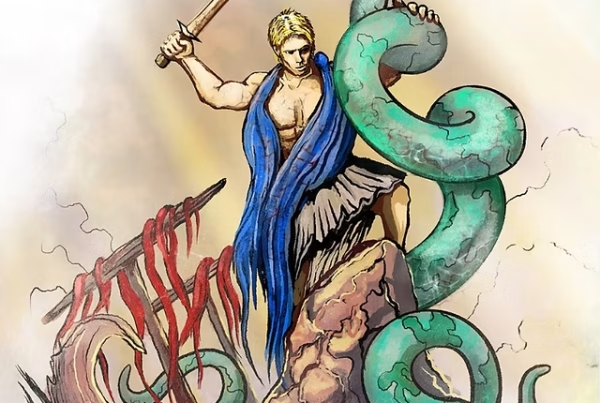
When I wrote my second book (which got binned for a good reason) I already had my Norse Gods in it, and a beta reader – who doesn’t read fantasy – said “all those Gods are sociopaths” and I jumped on the sofa and went EXCELLENT!!! That’s what they are! Your Gods, um, make mine look super sweet, humane, and totally mentally healthy…
Gods are, as you say, gods. They do what they want and think little of mortal interests! I wouldn’t say that ALL of my gods are horrible. There are a couple of nice ones! But ultimately, gods are quite selfish.Their mortals probably take after them, though.
Sooo there are a couple nice ones, whose names happen to escape you at the moment?
Well… this interview may include a few spoilers now… The Umber god, Unghard, is regarded as one of the nicest gods. Their mortals are stone-like golem beings who worship nature and believe that serving one another is a good thing, which in real life, is a good thing to a point. I’ll let you decide if Unghard IS good based on the events of the 2nd and 3rd book, but I believe they generally are when compared to the rest.
The other ‘good’ god is Mesmorpheus in my opinion, and lots of readers really like them. They’re the god of the Mesmer, who belong to the realm of dreams and stars. Many other mortals may blame Mesmorpheus for creating nightmares, and yes, Mesmorpheus isn’t perfect, but when you meet them in the book, I think they come across as likeable! They’re much like their mortals – mostly confused with reality.
I would say that, ah, Quen’s God sounds similar to a specific deity I have encountered on Earth. In fact, very similar. Does Quen’s – or really any character’s – experience reflect your experiences with religion(s)?
I grew up in a very Christian household and did a lot of Christian things, including Sunday School, hymn-singing, Bible classes, trying to convert people at my school cos they were probably going to hell, and the most defining moment of all this – going to some weird mansion in the middle of the countryside where I was meant to accept god’s blessings. At that exact point, I realized I didn’t want god’s blessings anywhere near me and I became an instant atheist. Well, maybe not instant, but the seed was there.
It’s probably Kayl and the Godless who reflect my thoughts and feelings on religion and the very concept of godhood. Kayl is outspoken and true to her beliefs. She argues with Quen about how the gods are cruel and don’t deserve our worship, and that’s exactly how I feel about religion in the real world. If god is a being that actually does exist, they don’t deserve our worship. I’d be asking why they created cancer, for a start. Maybe I played too many video games where “attack and dethrone god” was the main plot point!
Quen is the opposite of Kayl, and I didn’t really write him with that in mind, he just came out that way. He has a naive look at the world, but ultimately his journey does align with mine – to break free of his god and accept that not only are the gods cruel to their mortals, but they’re the true sinners of the universe, and they can’t be redeemed.
Twelve domains (thirteen, technically). Twelve (thirteen, technically) Gods. Twelve (…) races. How does one wake up and think “this is the easiest thing I can do?”
Ah, well, you see, I am partially mad, and this idea came to me during the pandemic quarantine days, which is when everyone was suffering from madness. No, I wouldn’t recommend anyone actually try and write twelve races and worlds like this, but it fit into the clock theme, so it seemed perfect to me at the time!
How did you manage to get enough ideas for twelve (thirteen etc.) races/Gods/worlds? Before even getting to the plot. Have you simply watched all the movies ever, read all the books ever, and that’s how you figured out what was left?
I take a lot of inspiration from video games and just throw them together, though the original building blocks came from when I was twelve. I had this idea for a character named Kayl who’d go hopping between portals and explore these elemental worlds. One was underwater, one was a casino inside a volcano. Sound kinda familiar? Kayl also had an entity or soul trapped inside of her that gave her powers. It was a very YA-feeling idea, and as I grew up, I realized it was a bit cringe. I didn’t know what to do with it so I shelved it forever.
And then the pandemic came, and I started a new Skyrim playthrough as you do. I love the steampunk elements of one of the races and others are treated like shit. This is what shaped the main character. The gods are inspired by The Elder Scrolls series. The Princes in the game’s world were god-like beings with their own dimension (or domain) and their own mortals, interfering with each other and playing around with mortal lives. They inspired my cruel gods.
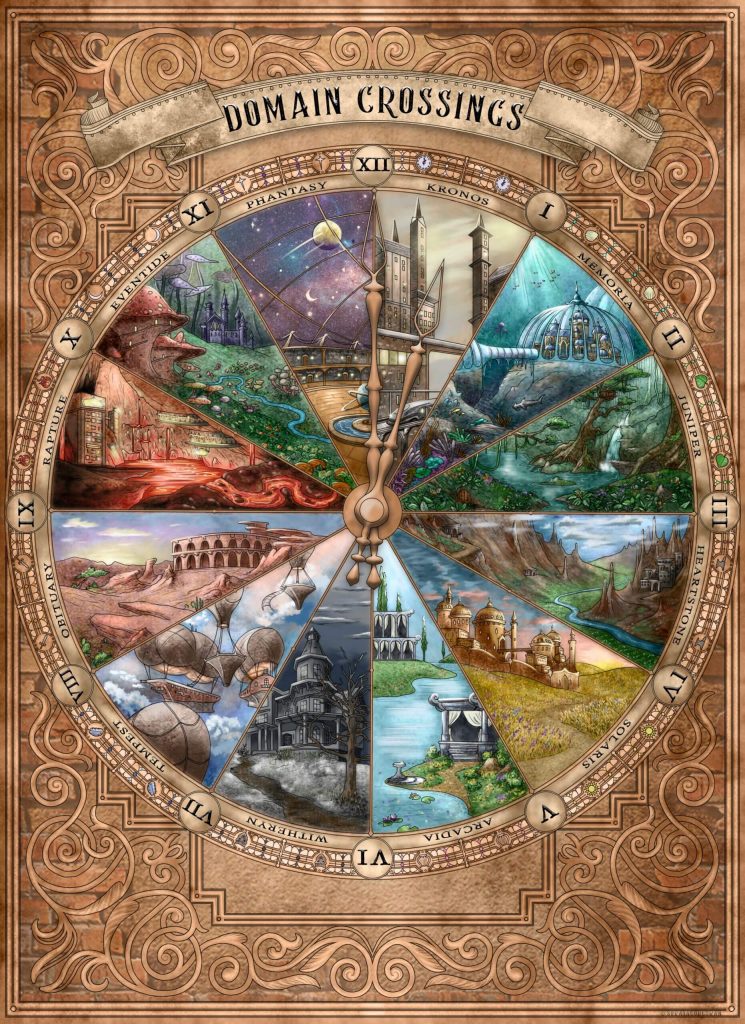
When I started thinking back to my twelve year old self and realized I could recreate my portal-hopping heroine, and from there the ideas just sort of spiralled out of control. I had the steampunk elements, but then the idea came of a clockwork design, portals that could be accessed via certain times, and from that I needed twelve domains and gods that would fit within the clock. From there, I took inspiration from the elements and from Fae-like worlds based on seasons by having a spring, summer, winter etc domain. These all became the domains I have now, the seasons, and also domains representing the past and future. I had my volcanic casino, another one was fire, earth, air… And with twelve domains, I was able to fit them inside a clock where some of them correspond with particular time of day or night.If you look at the clock map you’ll see that certain domains are opposite each other too, which was intentional. They’re natural opposites or compliment each other. The domain of time, for instance, is placed opposite the domain of death, because death is the natural result of time.
Because the world became a mixture of steampunk and clockpunk, it naturally settled into a British Edwardian gaslamp time period to match, and then became what I’d describe as obnoxiously British! I tried to make it worse by adding in as many obscure British references as I could think of, as well as some colourful British swearing.
I may have gone on a tangent there…
Your imagination feels endless. Don’t tell me that the series is now over, so you’re simply dropping all this incredible worldbuilding, gorgeous characters, and moving on to Tudor cosy romance…
I don’t think it’s possible for me to write cozy fantasy somehow! I’d like to return to The Cruel Gods world at some point in the future. I have ideas for a prequel spinoff featuring Gast the private eye, as I think the world of Chime with the gods fits a gaslamp noir setting perfectly. I also deliberately left The End of Time with a bit of an open ending so that I could return to it in the future, perhaps with a new series, maybe a new main character. But you’re right in that this world has so much left to give yet, and I don’t want to leave it for long.
Trudie or Tru?
So, you’ve been using the pronoun ‘they’ regarding some of your Gods… and your own pronouns changed in the bio at the end as the trilogy progressed. Was that related to the process of writing/self-discovery/self-therapy? And if yes, then how?
Some of the gods have specific genders, such as the Glimmer god, Gildola, being female and identifying as a woman, and Dor being male. Many are gender-neutral or have no gender at all. Some may even play with gender, such as Serenity, the Seren god, who changes between male and female, especially in the third book.
As for myself, yes, I started The Thirteenth Hour as a she/her, and slowly moved to she/they to finally accepting that I’m a they/them. I wasn’t sure for a long time, but throughout the development of this series, I came to realize that I was non-binary, perhaps more masc-leaning. It was at the back of my mind for years, but writing this series allowed me to explore a lot of these things. The Cruel Gods world is queer-normative, and through it I explore the gender and sexuality of these characters while also learning more about it. Writing queer characters also got me interested in reading more books with queer characters.
What do you mean by “accepting that I’m a they/them?” Like, have you sat and thought ‘hmm, let’s list pros and cons of both genders… uh… that’s not much in the pros column’?
It was kinda like that! For years I wasn’t sure what gender I was. I questioned whether I was cis or trans, and what did that even mean?
[bold quote]
What is gender? What is sexuality? Questions that just itched in the back of my mind
but out of the way enough I could ignore them in my daily life.
The question of gender bothered me for years, ever since I was a kid. I think. If I’d been born now with what I know of the world NOW, then things could be different. But when I was growing up, I’d never even heard of trans people, let alone non-binary people! I had no idea what demisexuality meant. I didn’t know about any of these things, so it took a few years of “Am I this?” or “Am I that?” before I finally felt… “okay yeah, I identify as non-binary”! This is definitely me.
But what does “I identify as non-binary” actually mean?
I think that answer would be different for every non-binary person! For me, it’s like… I don’t identify as a woman. I don’t feel comfortable as a woman. Just being a woman and talking about woman things makes me uncomfortable and I hate being labelled into a group that doesn’t feel like me. That’s a separate thing, because for a while I thought maybe I had some internalised misogyny going on – but no, I love women! There is absolutely nothing wrong with women enjoying feminine things, and I get very angry when men belittle things that women enjoy, it’s just feminine things aren’t for me, and that’s fine. That said, after accepting myself as non-binary, I actually feel more comfortable embracing my feminine side, and I really enjoyed writing Kayl (and also Jinx) who is a character that embraces her femininity and enjoys it, whereas to me, Jinx represents feminine rage. She embraces her sexuality and is rude in a society that enforces politeness. I love her for that.
So on the other side, I also don’t feel like I’m a ‘man’ enough to identify as male. I lean more masculine, I enjoy masculine clothing and styles, I like more masculine-coded hobbies, and there’s an element of masculinity that I identify with more… a kind of gentle need to protect, which is what inspires Quen’s character, and what I love about him.
Ultimately, I decided I fit somewhere in the middle without fully identifying with either, which is why I like non-binary. I also like the idea of being almost gender-neutral. The Mesmer of the Cruel Gods are largely non-binary, and I definitely identify with them!
Will you be changing your author name and bios in the previous books, or do you feel this is a period in time and it’s documented this way?
I actually have been going back and updating my profile to include my non-binary identity in my books. That’s one of the benefits of self-publishing – I can go back and update where I want! It’s just a case of remembering to update my profiles online if I forget!
I still go by the name of Trudie Skies for my books, just to avoid confusion. Tru is more of a preferred name. Though I’ve toyed with the idea of publishing under just Tru. Perhaps if I ever need a pen name.
Your books are definitely not chaste romances. They’re quite naughty at places (I use the word ‘naughty’ but various deities would either yawn ‘boring’ or ‘YOU HAVE SINNED, CHARACTER. COME HERE SO I CAN TORTURE YOU LOVINGLY.’) How autobiographical is that? (Why yes, I am nosy.)
I consider myself asexual, which is ironic because my books are full of some very horny characters! Kayl herself is sex-positive, and I always wanted to write a character that loved sex, because sex in books seems to get criticised a lot. God forbid a woman actually enjoys and wants sex! Lust is also a popular sin, and we see many sins explored in The Cruel Gods. My future books also seem to be quite horny, but I’d like to write more asexual characters and explore asexuality in depth.
You left Twitter/X a while ago. What was the last drop for you and don’t you feel that was not a very smart thing to do from the promotional point of view?
I left Twitter almost as soon as Elon Musk took over. I’d seen the writing on the wall immediately with him, and I honestly question why people are still using the platform. It’s full of bigots, TERFs, and Nazis. Why would I want to promote my books to such an audience? Musk himself is a walking human rights violation. I’m still selling books without Twitter, and I feel no urge to return and ruin my mental health. Bluesky has become my social media of choice and it’s growing bigger every day. I only hope it will fully replace Twitter.
Author Photo

Author Bio:
Trudie Skies is a non-binary author based in North East England, though they have been living inside fantasy worlds ever since they discovered books and refuse to return to reality. Within Trudie’s daydreams you’ll find SPFBO and BBNYA finalist The Thirteenth Hour, a gaslamp fantasy described as obnoxiously British and best read with a cup of tea.
When not conjuring new worlds, Trudie spends their free time exploring the realms of indie books and video games, staring at clouds, and chasing after their fluffy companions.
Social Links:
Website: https://www.trudieskies.com
Facebook: https://www.facebook.com/TrudieSkies
Instagram: https://www.instagram.com/trudieskies
Bluesky: https://bsky.app/profile/trudieskies.bsky.social
Goodreads: https://www.goodreads.com/author/show/19098964.Trudie_Skies
The Cruel Gods Series on Goodreads: https://www.goodreads.com/series/334434-the-cruel-gods
The Cruel Gods Series on Amazon: https://www.amazon.com/dp/B09HKYPPZ4