

“There is more than glory, brothers. Violence has made us strong, but only peace can make us eternal. I am done being a breaker. It is time for me to be a hero, to build something everlasting.”
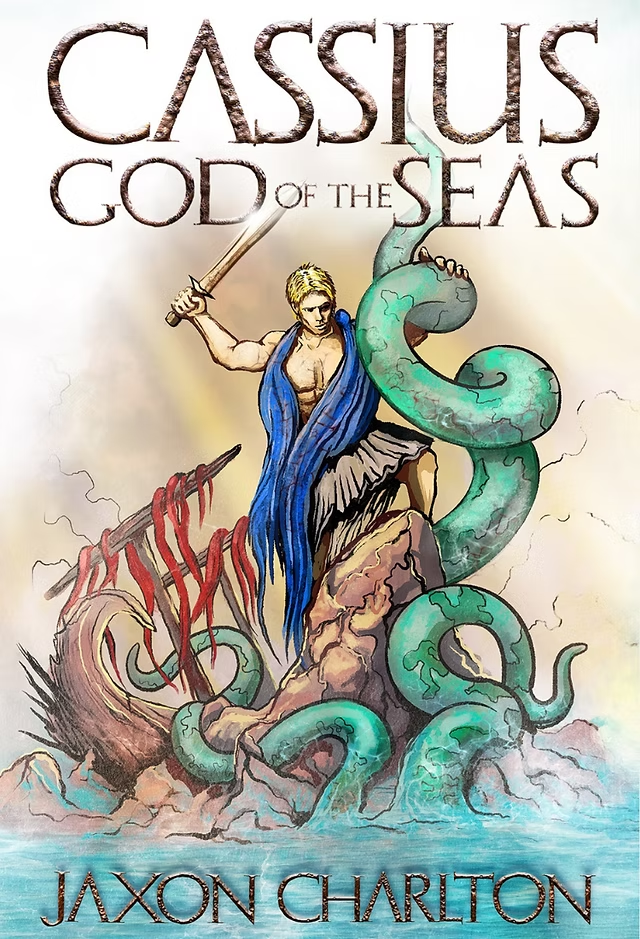
Gods! Mortals! Seafaring! Oh my! Cassius, God of the Seas by Jaxon Charlton is a secondary-world fantasy inspired by Greek and Roman mythology and culture. While it contains its fair share of darker scenes, I was most put in mind of the Percy Jackson series, and older fans of those books are Cassius‘s most likely audience. A prequel to Charlton’s successfully crowdfunded In the Wake of the Gods, Cassius reimagines  elements of Promethean archetype while exploring the reasons for the disappearance of the gods (and the reemergence of magic) in Wake. Despite being a prequel, Cassius does stand on its own (though it also does a nice job teasing Wake at the very end).
Cassius opens with a prologue told from the perspective of a goddess named Phoebe, but the novella’s protagonist is the titular god of the seas. The gods in Charlton’s world are very much part of mortal life, their daily interactions with humans most comparable to the Roman system of patrons and clients. Cassius is somewhat of an outsider among the gods, however, refusing to expend his magic to help mortals. The rest of the gods chastise Cassius for this, and as punishment, his magic is ripped from him. Even worse, he’s forced to take on mortal form, with all its weaknesses and foibles. As Cassius befriends a crew of seafaring mortals, he comes into conflict with the god of war, and his personal quest to regain his powers takes on greater meaning when a young girl he cares for is kidnapped by his rival.
I’ve mentioned it already, but one of Cassius‘s real strengths is that the story packs a lot into a small word count while still providing a clear narrative that doesn’t shortchange the conclusion. I did find the prologue section, which concerns a separate POV to Cassius himself, weaker than the rest of the novella, and it was unclear to me upon finishing the book what its purpose was. Otherwise, all significant plot threads feel both necessary to the story and are neatly tied up by Cassius‘s conclusion. In general, the novella’s powerful emotional moments are delivered well, and despite the (relatively) brief time spent with many of the characters, I found myself hoping things would turn out well for them. These sequences have just the appropriate level of melodrama to them, and alongside the action scenes are some of the best-drawn sections of the book. Fans of The Odyssey will recognize and delight in Charlton’s homage to the work, which goes beyond a simple retelling to craft scenes that feel new and specific to Cassius.
That said, although there’s a lot to praise, Cassius isn’t without flaws. One of the biggest hurdles for me was my initial navigation of the Greco-Roman (and I use the hyphenated term intentionally) world that Charlton has created. By the end, I felt more comfortable with the setting, but the ways in which classical Greek and Roman cultures are blended feels somewhat slapdash, and the presence of real-world names was handled a little awkwardly. Once I let myself sink into the book as a secondary-world fantasy, however, the more comfortable I became, but I do caution that readers of Italian or Greek descent may have a harder time with this one. Nonetheless, I suspect this may be an element that’s more smoothly handled in Wake, given some of the developments toward the novella’s conclusion.
Though there are some standout lines, the writing is also stilted in places, which has an impact on other important aspects of the story, such as characterization and the ability of the audience to become totally immersed in the world. The “curing” of a Deaf child is also a major plot point in the novel, and while it seems clear Charlton is writing from a place of good intention (as well as consideration for his setting), the centrality of that plotline to the novella makes it somewhat difficult to enjoy.
“The sea seemed to flee before his determination, breaking apart and weakening as he rowed with all his might.”
While the book has its problems, its most emotional moments remain powerful, and it’s clear that Charlton is a talent to watch. I was genuinely moved by several of the character deaths throughout, as well as by Charlton’s dedication of Cassius to a beloved late friend. In many ways, the novella has the feel of a coming-of-age and found family story, as the god Cassius learns to appreciate the mortals who surround him and is inspired by their struggles. Cassius also left me curious about Charlton’s novel, In the Wake of the Gods, which shows the novella’s doing a lot right.


