

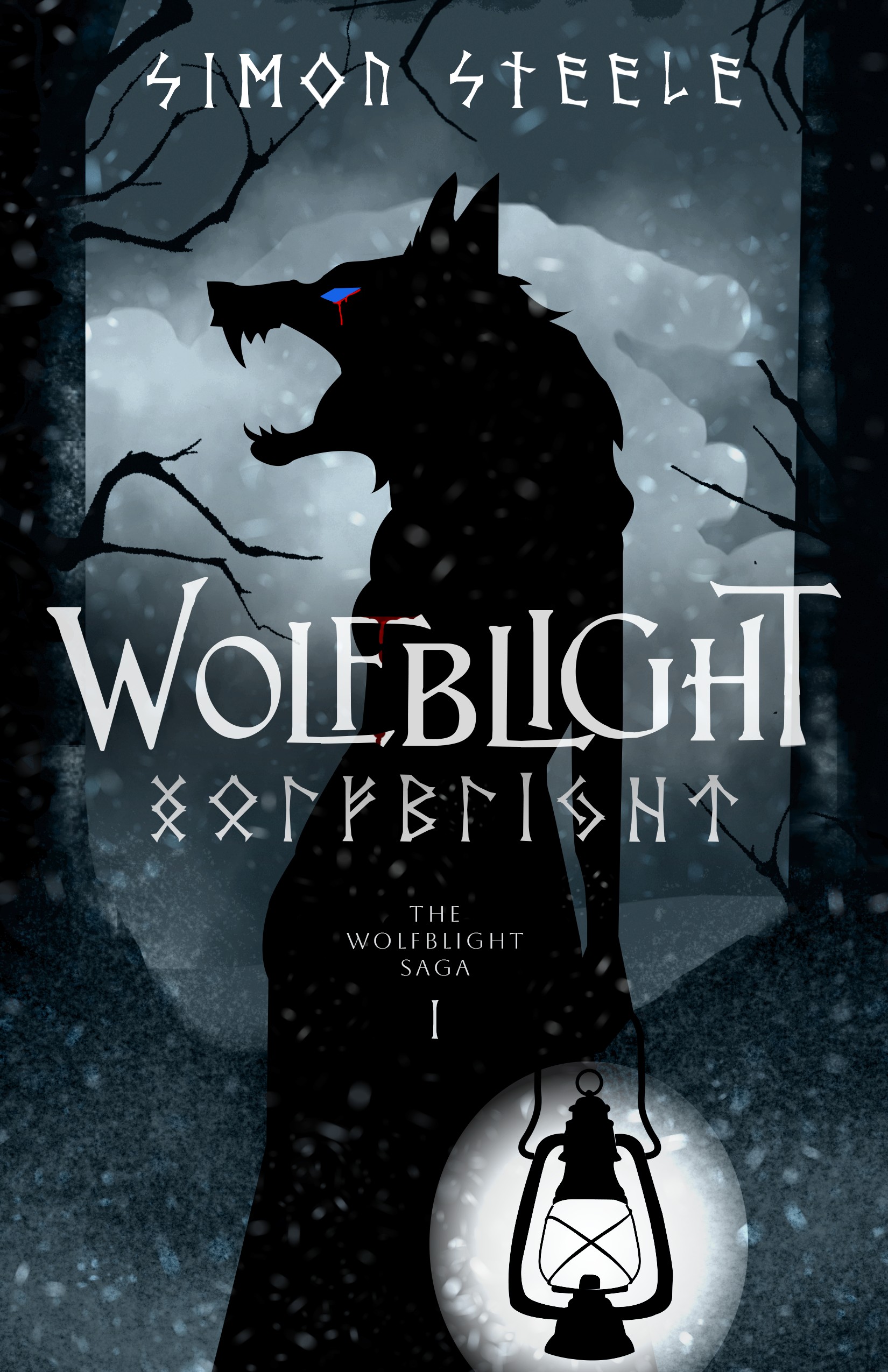
Wolfblight
by Simon Steele
A Tale of Love, Horror and Werewolves...
After suffering a terrible loss, Ulva and John settle into the village of Gormstad, hoping to start a new chapter in their lives. But their dream of tranquillity is shattered when Ulva is bitten by a werewolf one fateful night. Consequently, she is afflicted by a wretched disease known as the Wolfblight, which will transform her into a vicious beast every night and ultimately take control of her permanently unless a cure is procured.
With friends and family at her side, it is a race against time as Ulva sets off on a journey to reach a dark and mysterious forest known as Coldwood where a cure can be found, an ancient artifact known as Fenrir's Bane. But many horrors and nightmarish perils await Ulva and her companions. Will they triumph and reach Coldwood in time, or will it be too late?

SPFBOXI – Our Reviews
Noel Cober
“As he watched Ulva lick her wrist where the cuffs were chafing, Einar whimpered as he beheld his beloved sister. “I have seen the horrors of war and the deaths of thousands upon the fields of battle. None of it compares to what I see before me,” he said.”
When I saw that our team had been assigned a book about werewolves in a Norse-inspired world, I made sure it got assigned to me because that premise was so exciting that I couldn’t wait to read it. Wolfblight is a book about a woman named Ulva who is bitten by a werewolf and must go on a quest with her family and friends to cure herself of lycanthropy before it consumes her. But all is not as it seems, as a dark cult enacts a sinister plan, dogging them the whole way.
Wolfblight is a long book with a lot of characters in it, which are two things that I generally love. I especially love that a lot of them are either related to each other or close friends with each other, as it creates a lot of very obvious places for there to be complicated interpersonal dynamics between the group as they navigate this stressful situation. We don’t see quite as much of that as I would have hoped; I would say Wolfblight is more plot driven than character driven, so I didn’t always find that the characters got to shine as much as I’d have personally liked. However, that’s entirely a personal taste issue and not a strike against the book.
Author Simon Steele has written Wolfblight in a way that is reminiscent of a fairy tale; an ominscient third-person perspective that sometimes pulls out to describe the world and its history before coming back in to show us the characters again, which sometimes narrates in a mythological register and sometimes in a personal one. At the beginning of Wolfblight I assumed this was an intentional decision to frame the narrative with, but the longer I read the most I started to feel like it may not have been a conscious choice but rather the author struggling a bit to convey everything he wanted his reader to know in the confines of the story.
I also often felt the dialogue having this struggle. There are a lot of scenes where the characters talk for quite a long time about things that aren’t interesting. It’s realistic that, for example, a group of people would talk about whether they need to notify their workplaces that they’re leaving town abruptly, as happens at the beginning of the quest, but it ends up being nearly a full page of dialogue where the characters are conveying information to each other about where they work (which they all already know) and what their schedules are (which isn’t important to the story). It’s really difficult to write realistic dialogue that also propels the narrative, and unfortunately I often found that Wolfblight fell too hard on one side of that spectrum. The narration as well is often overly detailed where it doesn’t need to be. I think that more rigorous editing could probably have shortened this book by at least a quarter of its length without removing anything important.
The characters in Wolfblight are very archetypical, which isn’t a problem, but a lot of the personalities, especially Einar and John, do tend to blur together because of that. I also found points at which it was a bit difficult to take the villains seriously, such as when an evil sexy female werewolf alluringly declares “I’m not like other girls” before eating someone, or when the initial villain is introduced and is the most transparently evil character one can imagine, but somehow nobody clocks him until later. Most of the villains’ scenes come off campy in a way that doesn’t feel totally intentional to me. Even as they were very menacing, I struggled to agree that they were a serious threat to the characters. The werewolf hunter Vilhelm was the only antagonist who felt genuinely dangerous to me.
All in all, Wolfblight wasn’t quite what I’d hoped it would be. It’s a fun, action-driven adventure story about a family dealing with a tragedy, and it has cool mythological elements for Norse mythology buffs and werewolf fans. It ends in a way that will make you want to read the second book when it’s out, though!


