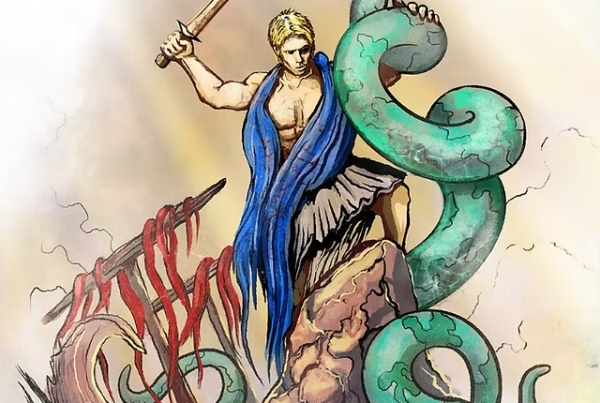
I started the Bjørn Again series, so that I could pick the most interesting authors and ask them questions I wanted answered. In Adrian M. Gibson I might have found the most most interesting author. The man puts ‘punk’ in ‘fungalpunk’. There is nothing ordinary about his first novel, Mushroom Blues, not just because it has an official soundtrack, or incredible artwork including full-page inside illustrations, or because it’s ‘fungalpunk noir’, or because it’s sort of edible if you’re into fungi very much…
Let’s carefully begin with a recipe. If someone were to grow fungi on Mushroom Blues, then literally eat the book, how should they go about it and what’s the recipe?
My love for both fungi and books knows no bounds, as my 5-minute mini-documentary (including a time lapse of the growth process) proves. But if anyone else were emboldened to try, the process of how to grow mushrooms on a book isn’t overly complicated. First, I had to place the book in boiling water, to sterilize the pages and provide a clean environment for the spores to take root. Then, after removing the book and cooling it down, I sprinkled spore plugs (essentially condensed pellets of spores) between the pages. I chose blue oyster mushroom spores, as that species is a) delicious to eat and easy to cook with, but b) it thrives on wood pulp as a food source. The next step was to place the book inside a vacuum sealed plastic bag, allowing 3-4 weeks for the mycelium to inoculate and grow out of the spore plugs.
From there, I built a makeshift “fruiting chamber” from a plastic tub, drilling holes on all of its sides for air flow. I placed the inoculated book inside, misted the interior of the tub 2-3 times a day, and waited for the mushrooms to fruit and grow. This was the stage that I also captured on camera, taking photos multiple times a day to track the growth for a DIY time lapse. After that, once the mushrooms were big enough, I took a bite on camera, then harvested and ate them! (NOTE: Oyster mushrooms sauté really well with garlic, butter, and salt, paired with a hearty protein.)
That’s literally ‘food for thought’.
Food for thought, indeed! I’d come across Merlin Sheldrake’s book Entangled Life (a fantastic non-fiction look at the world of fungi), and he’d grown mushrooms from a physical copy of his book. I figured, screw it, why not try that myself? There’s something magical to the idea that books can be food for something (in this case, wood pulp for oyster mushrooms), and there’s an even more meta narrative there about a story being consumed in such an outside-the-box kind of way. Eating my own words, as it were.
I also ate through your book, but in a different way… well, superfans know what to do next! #MushroomBluesChallenge is coming to YouTube literally right now. Anyway, it turns out that I really enjoy fungalpunk noir. Can you recommend some more authors established in this genre?
Fungalpunk is a genre I created. But, that comes with the caveat that I don’t deem my book as the first fungalpunk book. There are so many predecessors to what I’ve done, namely Jeff VanderMeer and a slew of authors in the New Weird movement. I adore what authors have done with fungi before I ever came along, but I wanted to give mushrooms their own subgenre, something that spoke to the playful nature of these organisms as well as their inherent uncanniness.
I took a broad approach to format, pulling inspiration from books, television, and film – Blade Runner, True Detective, and District 9, as well as the fictional works of authors like VanderMeer, China Mieville, and Philip K. Dick. In the span of a single sentence pitch/comparison, I wanted to impress upon people the best examples of atmosphere, storytelling, and mood that I possibly could. And with those comparisons laid out, the strange fungal world of my novel becomes more clear, but certain genre expectations are presented (namely noir, police procedurals, and murder mysteries) that a potential reader could find a comfortable entry point into my weird fictional creation.
Very comfortable. When you told me about your book, you said it wasn’t all that dark, and I was like “I see you are also inspired by authors who write humour?” and you were like “totally” and I was like “jumping in then” and then the book opens with a mutilated body of a child being examined by a policewoman…
Maybe my sense of humor is darker than most. Obviously, the opening scene isn’t humorous, and there are tons of scenes and trajectories in this story that are very dark and very heavy on an emotional and moral level. But, there is lightness sprinkled throughout. There are moments of levity between characters that reveal more about their relationships and their humanity. There are little jokes and easter eggs referring to author friends and music and movies, TV shows, and video games that have inspired me. So, yeah, I am inspired by authors like Terry Pratchett or Douglas Adams, but I take it more from an angle of light touches of humor to counter some of the darkness, as opposed to broader satirical works that sprinkle in darkness.
As I was reading, I had this thought – you have the humans, who are basically Americans/British, and the fungals, who are coded as, um, a recognisable Earth nation (except for the being mushrooms part)… Weren’t you afraid of getting ‘cancelled’ and #appropriation etc.?
I haven’t been cancelled, and for anyone who reads the entire book, they will understand that this is a more thoughtful approach to representing another culture. Sadly, I don’t have any lived experience as a fungal person, as much as I wish it were so. [Of course he does – BL] But reviews of people who “bounce off of” Henrietta’s character, of course, they mention her being a racist, but they never bombard me with accusations. It’s mainly, “I don’t vibe with unlikeable protagonists,” and they leave it at that. If anyone doesn’t get the difference between the author and the book, or is just judging based on a small sample (or no sample, at all, as is often the case), then that’s their prerogative. But so far, no criticisms on that front, and readers have found the full arc of the book to be really compelling and eye-opening.
Okay, my actual thought was “this book (NOT THE AUTHOR) is racist AF.”
This was a very conscious choice on my part. Yes, readers need to make the distinction that characters are not complete reflections of the authors. I’m not racist, especially toward my dear fungal people, but to make the main character unlikeable, discriminatory, and xenophobic was important for the story’s larger themes. The fungal people are subjugated by a nation of humans who’ve invaded them. There are difficult topics like colonialism, militarism, sexism, racism, and more that are broached through this complex sociopolitical dynamic between these two races.
In order for the world to properly come across, I made the main character, Henrietta Hofmann, someone who is uncomfortable and often opposed to the things going on around her. She’s also mycophobic, so being in a city of mushrooms and mushroom people is like hell-made-real for her. But all of this is a vehicle through which to explore the complex relationships and systems at play. Yes, the fungal people are directly inspired by Japan, Japanese people, their culture, customs, history, cuisine, religions, and more. But that wasn’t me saying, “It’s okay to be racist toward Japanese people.” I approached it as a love letter to this nation I adore in all of its various facets, highlighting the magic and nuance of a country that has been so misrepresented in the past.
Ultimately, as Henrietta experiences the events of Mushroom Blues, her eyes are opened not only to the false nature of her bigotry and the societal norms that perpetuated it, but she also develops an appreciation for the fungal people as a society, as a community, and as individuals, all of whom have fascinating nuances that are unique to them. Racism is not an easy thing to approach. It’s not comfortable in any way. But it’s a reality of our world, and therefore something fiction can engage with in an intelligent and compelling manner. The goal isn’t to make people more racist—it’s to encourage them to be more empathetic!
I remember noticing your book before it came out, as I scrolled down instafacetubex, and I never felt overtly advertised at. Then the book did come out and it earned out, as the Real Publishers call it, over… was it eight weeks? And by ‘earned out’ I mean ‘brought $2,500 in royalties’. You shared that on social media. Accidentally (really) right before that I saw another author’s post – after the release week, nobody bought their book. So, you’ve done something different. I mean, apart from all the other different things. When I started, I was reading about ‘building a platform’ – finding my future readers and connecting with them – and I was like “but how do I do that when I haven’t written anything yet?”
I’d written stuff before I built a platform—I just hadn’t taken writing seriously until after I built my platform. And that platform is a combination of things. I’ve been using social media professionally for years, primarily Instagram as a tattoo artist. So I had a following there, but those people were used to illustrations/tattoos/visual content. Back in 2021, I made several choices that sort of accrued into a “platform.”
The first was joining Twitter/X (whatever you want to call it now) and joining the book blogging community (specifically a blog called FanFiAddict). I also converted my Instagram account and started fresh there. Then, I began my podcast, SFF Addicts, which was the biggest pillar of everything I’ve done as an author. So that was all years in the making, and the podcast was basically my way to approach writing more seriously while picking the brains of talented authors in a “professional” manner. Writing was never a back seat thing, but it was all hand-in-hand with how I handled social media, etc.
You make this sound so easy. “I simply joined Twitter, then I joined FanFiAddict, and started a super popular podcast.”
Conceptually, all of these things can be easy. They’re ultimately boiled down to a) decisions (based on skills I have and what I know I can manage), and b) having the confidence to follow through on those decisions. I’m a pretty impulsive person, i.e. I go with my gut more often than not, and that has led me to dive headfirst into a ton of different things across the span of my lifetime. If it weren’t for that confidence in trusting my gut, I never would’ve lived across the world, or started a (brief) career in journalism, or a (longer) career in tattooing, or now with podcasting and writing. It’s kind of innate to who I am, and not everybody is like that. So it’s all a matter of navigating what you know about yourself and how that can be applied to X, Y, and Z.
$2,500 sounds like a lot of money. Isn’t writing a book just poking the keyboard for a while and then uploading it to Amazon, for the joy of creating art and sharing it with pirates? I mean, people?
$2,500 is a lot of money, but I know tons of self-published authors who invest twice that (often even more). At this stage in the publishing world, authors have to be so much more than “an author who tells stories and leaves it at that”—very few authors can actually manage that. Being an author in today’s environment means being an entrepreneur, especially in the indie sphere. Obviously, I took on more than the average author (with my background in graphic design, or familiarity with Adobe software that I felt comfortable doing the entire interior design of my book in Adobe InDesign), but every author has to find a balance between writer/manager/creative director/marketer/etc. There’s a lot to take on, if you want to be able to make a mark.
While this may sound overwhelming, these are skills that life can teach you before you ever publish a book. Whatever your work experience may be, or the people around you, we absorb a large suite of skills that aren’t noticeably useful to this career path until it hits you in the face. Then it’s like, “Oh shit, this just saved my ass!”
Have you had some sort of a business plan? I mean, $2,500 is an investment – many people (most?) don’t make this much money per month, not to mention saving it. Was it like, “once I hit this many followers, I’ll be ready” or was it all instinct, “this is the moment?”
Mostly instinct. I’ve never been one for business plans (that’s more my wife’s domain). I’m in a comfortable situation in that I’m a stay-at-home dad and my wife works for a family business. That allowed me to slowly gather all the resources I needed in order to make this a reality. It was never about a certain number of followers or waiting for the “right time,” I just set this goal for myself with a timeframe in mind (spring 2024), then went for it as hard as I could.
In terms of the investment I made into the book, I’m lucky in that I have alternate income streams (Patreon for the podcast, an online store with merch, selling semi-permanent tattoo designs on a site called InkBox), that I actually paid for over 50% of the book from all of that combined. I also skirted a lot of massive costs for authors, mainly cover and interior design, by having a background in graphic design and tackling those aspects myself. So, I’m very fortunate in that sense, but I still understood that I didn’t want this debut novel venture to fall so flat that I’d lose out on $2,500. As a result, I put everything I know into marketing.
It helps to have the graphic design skills – I’d know best. I’m nosy and have no manners, so, what exactly cost you so much?
In my case, $2,500 went directly to:
- Cover art
- Editing
Cover art and editing are the biggest costs for any self-published author, hands down. And both come with a wide ranging price tag, so you have to be very diligent about doing your research ahead of time. Who did this cover I adore? What’s the lead time on booking a cover with them? What is their cost for a front cover vs. wraparound cover? On top of that, design can be a massive investment. Most cover artists don’t do design! They just do art. So, you have to hire a designer on top of that, someone who can handle the typography and layout of your cover, fitting the synopsis, blurbs, ISBN code, etc. on there. Add to that, the design of your book’s interior: the layout and typography of title pages, glossaries, dedications, chapter headings, body font, spacing—the list goes on and on.
Then, there’s editing, which is basically a gatekeeping method for your story to not suck complete ass. Look at the acknowledgements of your favorite indie books and see who the editor was! Most freelance editors have reasonable rates (a price per word) and schedules, so please, don’t skimp on this step. Getting your book in front of an experienced editor will do so much to elevate the quality of what eventually is released to the public.
I also made the added decision to hire two friends of mine from Sweden to make an official soundtrack for the book, so that added a few hundred dollars to the final investment. But a soundtrack is not in everyone’s budget, nor is it necessary. Just an extra thing that meant a lot to me, and was fun to collaborate on with people whose talent I respect.
Enough about money, let’s talk about numbers. That investment paid for itself when you reached about 600 sales. Authors are told to write to the market, check the trends, etc etc. You went and created your own genre. How do you find an audience for a genre that didn’t exist before you invented it?
I hate phrases like “write to market” and “check the trends.” Those phrases are essentially ways of choking your creativity. It also implies that the market is slow and that trends can be easily forecasted. In reality, the market shifts in unexpected ways and nobody knows what the fuck a trend will be until it’s already a trend. So chasing that is a never-ending rat race. You’ll always be behind the trend because you’re not the person trying to create a new trend.
And that notion of “new trends,” it’s not even a conscious thing. Most of the trendsetters don’t outright know or seek the path of setting a trend. They do a thing that they want to do, and if it catches fire, well, that’s an unexpected bonus. Write what you want, what feels true to you and your life, the story that resonates with the deepest fibers of your heart and loins. Those are the stories that will invigorate you to write, and will be filled with the most genuine representations of what it means to be human. Those are the details that readers will sink their teeth into and will keep them turning pages, despite the fact that you may not even be conscious of detail X being the detail that will completely pull a reader in.
I honestly don’t know how to tell an audience about my story, cause I just wrote it honestly and I’ve been marketing it honestly. I know that’s not helpful, but the best things in my life have come from being genuine, so if readers gravitate toward your story based on the cover, or the synopsis, or the comps, etc., you better make damn sure those things are the best fucking reflection of you and your story as possible. Cause that will convince a reader more than anything. Mushrooms will always be playful for me. How anyone else translates that, it’s up to them, haha!
I love that this book has both a Spotify playlist and an actual official soundtrack.
This is all just a natural extension of things I love. I was inspired to do the Spotify playlist after my friend Nicholas Eames did it for his books Kings of the Wyld and Bloody Rose. It’s just such a cool addition to a medium that is audibly silent! So, I took it a step further: I made a playlist with one song per chapter (there are 40 in total), pulling from musicians who inspired me and this world, as well as songs that I listened to while writing.
On top of that, I collaborated with two friends in Sweden (whose production duo moniker is Sporer) to create an album of original music for the book. They’re both big fans of mushrooms and are incredible musicians, so they were fully on board. Throughout the fall of 2023, they did a handful of jam sessions, creating dozens of short samples. We went through the samples and picked eight tracks that best reflected Mushroom Blues. They then expanded upon those tracks, fine tuning and mastering them. Anyone who gets a physical or digital copy of the book, if you go to the very back, you’ll find pages with QR codes that take you directly to the Spotify playlist or the album’s Bandcamp page.
It was also so fun to incorporate cassette tapes into the very story itself. First off, I love music, I was a music journalist, and I listen to music every day. Sporer also printed a limited edition run of cassette tapes of the soundtrack, so it felt so perfect. Throughout Mushroom Blues, Henrietta is listening to cassette tapes that she inherited from her father, mostly a genre I created called pilzrock. They’re a place of comfort for her, much like music is a place of comfort for me. It also gave me the opportunity to throw in references to friends and bands in the track titles.
Thank you so much. I’ve learned a lot about…all of the above. And – who knew the way to find success is not to try to be like everybody else? Adrian M. Gibson, that’s who.
SOCIAL LINKS:
Twitter: https://twitter.com/adrianmgibson
Instagram: https://www.instagram.com/adrianmgibson/
Facebook: https://www.facebook.com/adrianmarcgibson
Amazon: https://www.amazon.com/author/adrianmgibson
Website:https://adrianmgibson.com/
BIO:
Adrian M. Gibson is a Canadian speculative fiction author, podcaster and illustrator (as well as occasional tattoo artist). He was born in Ontario, Canada, but grew up in British Columbia. He studied English Literature and has worked in music journalism, restaurants, tattoo studios, clothing stores and a bevy of odd jobs.
In 2021, he created the SFF Addicts podcast, which he co-hosts with fellow author M. J. Kuhn. The two host in-depth interviews with an array of science fiction and fantasy authors, as well as writing masterclasses.
Adrian has a not-so-casual obsession with mushrooms, relishes in the vastness of nature and is a self-proclaimed “child of the mountains.” He enjoys cooking, music, video games, politics and science, as well as reading fiction and comic books. He lives in Quito, Ecuador with his wife and sons.
Mushroom Blues is his debut novel.
Review of Mushroom Blues by Bjørn on Queen’s Book Asylum.
https://
Author Photo