“The Speculative Fiction Indie Novella Championship (SFINCS, pronounced “sphinx”) is a yearly competition to recognize, honor, and celebrate the talent and creativity present in the indie community. We are a sister competition to both SPFBO and SPSFC, and we highlight greatness in the novella format in all areas of speculative fiction (fantasy, science fiction, horror, etc.).” – From the official SFINCS website.
Note: The following review contains only my personal thoughts as a judge and does not reflect the views of the team as a whole.
REVIEW
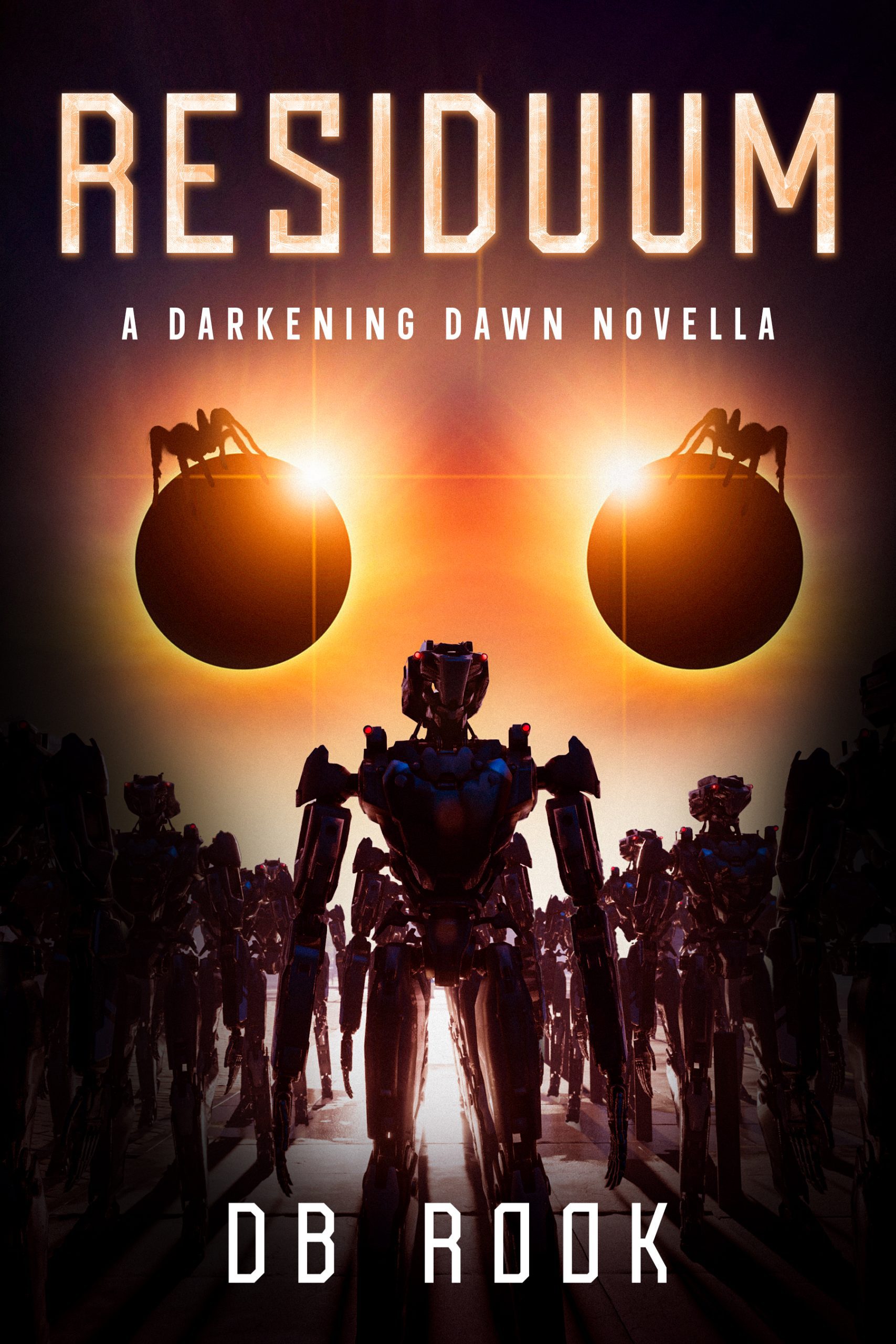
D. B. Rook’s Residuum is a pacey, genre-blending action-horror-sci-fi that takes some big swings in terms of how much it packs into its short format. Set during a robot apocalypse, after the human world has been destroyed by overlords known as the Black Bots, it has a cinematic feel that for me draws comparison with videogames, television, and film. Although the novella’s opening may not showcase this element, I would recommend Residuum to fans of Firefly, while the post-apocalyptic, dystopian setting may also appeal to fans of C. Robert Cargill’s Sea of Rust and its sister stories. Residuum is the first in a series, and if it’s anything to go by, readers are in for a wild ride and a lot of fun as Rook develops its universe and characters further.
A lot happens in Residuum. The first third of the novella reminded me very much of a survival horror videogame (one of my favourite game genres). When we meet our first characters–a teenage girl named Charlus and her mother, Merrian–the pair are sneaking and fighting their way through a Gigeresque, industrial landscape. Charlus and Merrian’s chapters showcase a bleak world in which bare survival–indeed, bare  life–is as much as can be hoped for. Structurally, their flight from the Black Bots contributes both to the videogame feel of the text, as well as to its fast pace. Sections of stealth, flight, and combat put one in mind of the gameplay sections of Resident Evil 2 or maybe Dead Space, punctuated by more dramatic scenes wherein the family meets fellow survivors and which read almost like videogame cinematics. Newcomers to the narrative are often dispatched in grisly, memorable ways, and although the novella is by no means wall-to-wall violence and gore, what is there will likely satisfy horror fans. Beyond the raw desperation of their flight, however, there’s also an added element of mystery to Charlus and Merrian’s situation. Charlus’s late father had something to do with the Bots, and the audience is kept guessing whether he was a well-meaning victim, or the mastermind responsible for current dystopian weather conditions. Without ruining the story’s surprises, Merrian and Charlus aren’t the only central characters, and around two thirds of the way through they stumble across a crew of pirates who may be Charlus and Merrian’s only chance. Here, the novella incorporates additional sci-fi elements, with a focus on action.
Residuum‘s pace is one of its strongest features. At a line level, character action is very clear. While there are some grammatical issues or moments where the wordchoice is ever-so-slightly off, you almost don’t notice due to the propulsive pace and a compulsive readability. Charlus and Merrian’s circumstances are also sufficiently fraught with danger that it’s difficult to stop from turning the pages, and short, punchy chapters aid the book’s overall readability. Comparatively few authors, it sometimes seems, really think about chapter length as a facet of craft that can be manipulated to produce an effect, or as part of the artistry of the writing. Rook’s attention to that detail is therefore wonderful to see, and he makes use of it to great effect. Although I’m hesitant to call Residuum a thriller (especially on top of all the other genres I’ve thrown into the mix), it has the readability of one. As a survival horror fan, I also found myself wishing I could reach into the book and play various sections, and for me there was an almost nostalgic quality to the work. Despite all the death, blood, and mayhem (or, perhaps, because of it), I found myself feeling quite at home.
Without spoiling the plot, one of the most distinct aspects of Residuum is its shift from genre to genre. That first third of the book has a strong horror inflection, while the second has more of a heist or action movie feel (my immediate point of reference was The Matrix and particularly the crew of the Nebuchadnezzar), and the final third is reminiscent of Firefly both in terms of how Residuum balances dark subject matter with humour, and in terms of its set pieces and plotting. Needless to say, Residuum will almost definitely journey to some places you didn’t expect. While I loved the ambition of this, I did feel that the short length of the piece meant that certain aspects of these genre and story shifts weren’t able to be fully explored. The final third in particular introduced a lot of plot developments and tonal changes that didn’t feel as though they’d had quite enough time to bake in order for them to carry the weight they needed to. In general throughout, although a lack of infodumping certainly contributed to the fast pace, the lack of context in terms of the world means that some of the elements that are introduced feel a little out of left field. Occasionally, especially in that last third, I also found myself flipping back the pages to see whether I’d missed something, often because an event happened off page, was remarked upon in narration, and then was resolved off page. This added to the sense that the conclusion was perhaps given short shrift compared with the opening. Although I very much enjoyed Charlus and Merrian’s struggle in the book’s first third, my impression is that the data-pirates are of the most interest to Rook as an author. It seems likely that these characters are the focus of later planned stories. If my suspicions are correct, it feels as though a little less time ought to be devoted to Charlus and Merrian’s flight, so that the character dynamics and plot developments of the climax have more room to breathe.
“‘They judge us . . . Their algorithm drives their decisions and they take out those with the highest scores first.'”
Charlus and her companions are easy to root for, and I especially enjoyed one of the data-pirate crew members, Tapedeck, who’d I’d go so far as to call loveable. The themes of found family that are introduced partway through show a lot of promise, and I’m excited to see how Rook develops the characters in future volumes. The hints we saw of familial dynamics between crew members, as well as Charlus’s own shifting relationship to family, are certainly fruitful ground. Overall, character POVs are fairly distant and we do tend to be told rather than shown how the characters are feeling. This does mean that there’s perhaps less deep of an emotional connection between the reader and the cast. This isn’t always a negative, especially in a work that’s more action and plot focused. Too much interiority risks killing the pace and bogging down the text. That said, a (very) slightly tighter POV could have complemented the breezy, snappy pace and helped me sink more into certain scenes.
There’s a lot to applaud in Residuum and I can easily say I had a fun time with the book. I have a feeling that it’ll be a crowd pleaser due to its aforementioned fast pace and its found family dynamics, and readers who who are also big gamers will likely really appreciate the structuring of the scenes and the focus on action. Somewhat obviously, perhaps, but it’s also worth a look for sci-fi readers who love robot apocalypses (robocalypses!), and my impression is that by integrating additional science fiction elements, Rook is bringing something new to the table in terms of worldbuilding.
Buy Residuum from Amazon.
Add Residuum on Goodreads.
Add Residuum on Pagebound.