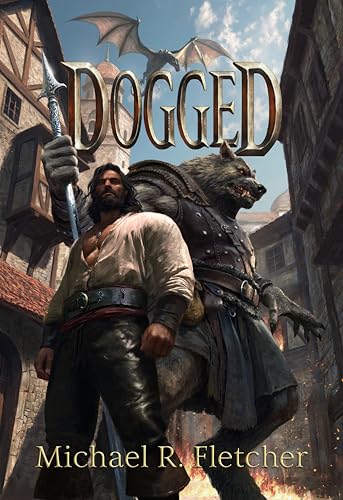
Dogged
by Michael R. Fletcher
WARDOGS ARE BORN TO DIE.
In the final days of the Demon Empire a lone wardog goes in search of the answer to the only question she cares about: Who murdered her mate?
Utterly unqualified to solve a mystery, Dogged Determination has but one advantage: She never, ever gives up.
From the heart of a massive empire to the deepest foreboding jungles, Dogged is an unstoppable force of will.

SPFBOXI – Our Reviews
Catherine Catcho
(lookma.i.read)
“What are the poop rules here?”
I know this feels like a weird quote to pull, but honestly, it’s a a critical question for Dogged, a female wardog on the hunt to understand who killed her husband. Yes, she’s pretty intimidating but poop locations are important and she’s trying to be respectful. To be honest, Dogged is actually pretty thoughtful. (Though she would claim she doesn’t know what a lot of things are like “compromise” or “numbers”.)
When Dogged meets some humans that help her on her assignment from the Demon Emperor (which she whole heartedly believes is the good guy), she’s forced out of her social comfort zone.
I tore his tongue out so he couldn’t manage even the simplest incantation. Releasing the unconscious man, I stood chewing as I wondered how dangerous this Airyn Thelm would be. Probably very, I decided.
“Did you just eat his tongue?” Balen asked.
“Soft and delicious,” I answered, swallowing. “If we weren’t in a rush I’d eat his liver, heart, and kidneys as well.” I hesitated, realizing what I’d done, and felt a rush of warm embarrassment. “Sorry. That was rude.”
“It’s—”
“I should have offered you some.”
“Nope. Not hungry.”
See what I mean? For a wardog, it’s tough to navigate the humans (and vice versa).
I liked this for the same reasons I liked our team’s SPFBO 11 finalist pick, Jester. Please give me an unexpected underdog (but in Dogged, the pun feels literal) that we can root for some type of justice.
As a dog owner, this book made me smirk, because we often wonder what our dogs are thinking. So giving voice to this breed gave it kinda a satisfying vibe.
I think I struggled a little with the simplicity of Dogged’s thoughts even though she was advanced enough to talk, get dressed and yield weapons.
That being said- it was a smirk-worthy read and I was glad it made it in the finals.
Noel Cober
Usually, at this point, people started babbling and backing away and stinking of sweet fear, but he stood there like annoying a wardog was nothing. Maybe I was nothing.
I decided to check.
Over the course of a normal day of service to the totally benevolent Demon Emperor, travelling off to a faraway world to bring peace and prosperity to it by killing everyone there, wardog Dogged Determination’s mate gets killed when a portal collapses and cuts him in half, along with a bunch of other wardogs. It seems that the gentle Demon Emperor and his lovely wife, the Queen of the Dead, have a problem either with something going wrong or with someone attacking them, and it’s up to Dogged to find out why.
Okay, I should back up a bit, actually. It’s Dogged’s job to find out who killed her mate, and everything else spirals from there. Michael R. Fletcher’s Dogged is a strange book in many ways and one of those ways is that it’s constructed like a mystery as Dogged follows the trail to the person who killed her mate, but what is actually happening is pretty apparent to the audience pretty early on. Usually in a novel about someone solving a mystery you have a protagonist who is smarter than the audience, who sees clues that we don’t and who figures things out using logic that seems inaccessible to us. This book is the opposite. Dogged misses or ignores information that she decides isn’t interesting or relevant, forgets suspects’ names, and doesn’t really know what she’s doing until it’s time to dismember someone. But she muddles through on a charming adventure where she makes friends and (maybe) learns that maybe her life can have a bit more meaning than just to die in service to the Emperor.
Dogged’s voice is what really sells this book. She’s got a very straightforward way of seeing the world, ignores challenges to her worldview, and thinks mostly like a dog. Dogged is by no means a comedy, but there are a good number of funny moments where she says or does something very doglike after acting like a person for so long. It’s really hard to write the same joke thirty times and have it still be funny the thirty-first time, but Fletcher impressed me by pulling that off; I smiled every time one of her doggy behaviours became evident. The narration is very basic because Dogged’s vocabulary and way of thinking about the world are very basic, and it comes across as very intentional to me, which I liked. I will say that the persistent refusal to use the past perfect where it was called for irked me by the end, but it was, I assume, also a stylistic choice that conveys Dogged’s voice (and lack of understanding of the passage of time) really well, even if my personal grammatical sensibilities were displeased about it.
Dogged is a really good, interesting character with a lot of personality. Second to her in terms of personality is her mate Vigilant Aggression, who also comes across really clearly throughout the book despite being dead in the first few pages, which is also very impressive to me. The other characters I was less impressed by, probably because of how Dogged views people, most of them felt very shallow and though I could guess at motivations and internal thoughts, none of them really ended up sticking with me because even the characters Dogged felt very attached to ultimately came off a bit too superficial. A few of the characters don’t seem to have clear or consistent motivations because Dogged doesn’t pay them enough attention to let the audience guess what they’re doing or why. The book has a very small cast, which should work in its favour given what I just said, but it didn’t really help the characters stand out that much for me.
I’m one of those annoying people who reads ten chapters of a mystery, figures it out, and spends the rest of the book being annoyed that I have to wait for the detective to find the rest of the clues. For that reason, I did feel a lot of frustration reading the middle part of Dogged, where it’s fairly obvious to the reader (intentionally) what is going on and Dogged isn’t seeing it. I do respect the fact that this is intentional and that I am just not responding the way Fletcher probably wanted audiences to respond, but it was how I felt in the middle, especially because a lot of ideas and information kept getting repeated by our hero who didn’t remember that she’d told it to us before, but I remembered and didn’t need it repeated. I felt like the last quarter was also a lot of things happening without explanation (to Dogged or the audience) and part of me really liked that because I like the idea that the main character of the book isn’t the main character of the world and most of what’s happening is really just happening around her and her friends, but for a while it did get to be a bit much for me. Fletcher came back in and made the stakes at the end more personal though, and I did like the actual climax of the book.
The world in Dogged is really complex and interesting and I loved the tidbits we got of all the different types of magic, the different historical stuff that was going on, the different races and places. It all felt very real and interesting and a lot of it was very unlike anything I’d read before. I like that it was mostly background because it mostly wasn’t interesting to Dogged, and I did sometimes feel like I was walking a huge and ornery dog that was more interested in sniffing stop signs than leading me to any of the interesting (to humans) things on the road. That was a fun feeling and I enjoyed getting to learn more about the world through the eyes of someone who finds it entirely unremarkable.
Based on the cover, title and synopsis, I did not think I’d be coming away from Dogged thinking “that was cute,” but it was. I thought it was a cute, fun adventure that follows a cool character through an interesting world and I enjoyed reading it. I wouldn’t call it lighthearted because it does get a bit dark at times, but I’d definitely recommend it to someone who wants a different perspective on the evil fantasy empire, and who wants a pulpy (the urge to write ‘puppy’) adventure that manages not to get too heavy thanks to its protagonist who, just like a dog, always manages to stay her personal brand of optimistic no matter what happens.
Angela Boord
I went into this one with a little trepidation, never having read a Michael Fletcher book but knowing Michael Fletcher’s reputation as one of the grimdarkiest of grimdark writers. I was really happy to discover that Dogged was like watching an 80’s sword and sorcery flick (complete with metal soundtrack). There’s a lot of nostalgia here for classic fantasy adventure paired with a world insane enough to warrant the metal soundtrack, so if you’re looking for that kind of look back and a protagonist you can unequivocally root for, you’ll probably want to pick this one up.
The plot sets up simply enough, and the simplicity of it keeps the epic in scope. Dogged Determination’s mate, Vigilant Aggression, is killed by a portal that collapses, and when she asks why, she finds herself tasked with the official investigation. True to her name, she pursues this investigation with “dogged determination”, but since she’s a wardog, it makes things hard because she feels like she’s not that smart and nobody expects a war dog to be a person. Wardogs are used by the Demon Emperor as weapons, and as Dogged says often, wardogs are born to die.
First, let me say that one of my favorite things about this world is the way the wardogs are named. My other favorite thing is the quiet and subtle characterization that sneaks in around the edges.
“Finished with the last knot, Sahar stepped back. “I’m sorry. Do wardogs…” She cleared her throat. “Did you love him?”
My head ached and my chest felt like my lungs were filling with ice water. Remembering Sahar’s ancient rusting chest, I imagined dropping the box with my pain inside it and burying it in the endless jungles north of Aszyyr. There had to be somewhere I could put it where I would no longer feel the pain.
My claws sank into the rail, splintering wood.
He was mine.”
Much of the characterization ends up being “around the edges” because, though we’re in Dogged’s POV the whole time, the other characters see her and bring up perspectives that never occur to her. These outside perspectives provide the scaffolding to bolster what the reader already feels is true about her character, or at least that’s how they worked for me. This kind of characterization provides a lot of depth to what is otherwise a pretty straightforward adventure story. Every time I came to one of those moments between the characters, I found myself wanting to savor it. I often ended up reading them over again, just to sit with them a little longer.
This strength became kind of a double-edged sword in the last third of the book, though, when the story shifted away from the character moments to more predictable action. I felt like it also muddled the plot; in the end, I wasn’t sure if or how the big chases made sense from the villains’ point of view.
Switching to an action focus also felt like it made the story plow on to the end without Dogged being challenged in a way that would be hard for her. Wardogs are born to die, but they’re not born to be detectives, spies, or to live among people, and that’s where the tension in the plot lay for me. Dogged has been facing grave peril all her life, so even though I was worried for her, it didn’t draw me in as much. (And there were other moments when things just resolved without the characters having to do anything, which also deflated the story a bit).
Overall, this was a fun read with some great character moments that breathed new life into all the old sword and sorcery tropes. I’m really glad I got the chance to read it, and I’d recommend it to anybody who wants to spend a couple of days with a giant dog barbarian who’s more human than many people.
Steve Hugh Westenra
“Sometimes . . . I like to imagine what I’d do if the palace was attacked. I imagine demons pouring into the halls and rushing out to face them.” I closed my eyes, remembering the dream. “I picture the faces of the people when they realize I am there to protect them. Usually, I defeat the invaders, and the people gather around to scratch behind my ears, but sometimes I fall defeating the very last demon. The people stand over me as I die, and I see their eyes are wet and sad and those are the best dreams ever because I know that they know.
Dogged is the second book I’ve read from Michael R. Fletcher, so, in case the hype around both him as an author and this specific book weren’t enough, I went in knowing to expect stellar prose and confident storytelling. Hype and expectation can be treacherous things, and in general I’m very hype-averse (which itself is rather unfair–sometimes a work is popular for good reason). Happily, when it comes to Dogged, there was no need to worry that the positive chatter would sway me one way or another, as the book succeeds very well on its own merits. A fantasy comedy that combines elements of mystery and action in a novel that approaches a deconstruction of the fantasy genre, I’d recommend Dogged to fans of fellow SPFBO finalist Tim Carter (including his works Jester and Majordomo), along with fans of Nicholas Eames’s Kings of the Wyld. With Dogged‘s focus on a non-human, anthropomorphic protagonist who’s indoctrinated into serving warmongering humanoids, there’s also something here for readers of animal-focused stories like Grant Morrison’s We3.
Dogged Determination is an unlikely fantasy protagonist. More-or-less a gnoll (a race of bipedal anthropomorphic hyenas popularized by Dungeons and Dragons), Dogged serves at the behest of the innocuously-named Demon Emperor alongside her fellow canine shock troops. Wardogs like Dogged and her mate, Vigilant Aggression, prize obedience, endurance, and loyalty above all. If anything comes fourth in that list it’s the love of the fight and a belief in the inherent goodness of dying in battle in service to one’s master. Dogged Determination’s rigid faith in the simplicity of her universe is shaken, however, when Vigilant Aggression and a number of their fellow wardogs are killed not in glorious combat, but by a portal that mysteriously closes on them as they’re being transported to a distant world. When it turns out hers wasn’t the only portal to close–impairing the army’s ability to spread the Demon Emperor’s peace across the multiverse and stranding the Demon Emperor in a distant realm–the wardogs’ death becomes far more than a personal tragedy. To everyone’s shock (most of all Dogged’s) the Demon Emperor’s second-in-command tasks Dogged with investigating why the portals closed and who is behind it. Dogged may not have full command over what a metaphor is, but true to her name she never gives up, and as she comes to realize, she’s capable of far more than she ever believed, including making friends.
Much of the draw of Dogged lies in its premise–a dog’s perspective on a fantasy world and her heartfelt struggle to be good in the eyes of those she loves and would protect. It’s hard not to be drawn in by the concept, or by Dogged herself, who is immediately and consistently likeable despite her willingness to tear people’s limbs off when the opportunity arises. Along with being a draw, however, the concept also risks limiting the story–Fletcher could easily have treated Dogged’s dogness as the only important element of the story and moved on to something different. Where Dogged succeeds most, however, is in how Fletcher uses the character to engage with deeper questions to do with authority, loyalty, and even how we conceptualize and limit ourselves based on a lack of self-worth. Much of this is conveyed through Dogged’s recollections of Vigilant Aggression–the character who, aside from Dogged herself, most leaps off the page (and after the stick). It’s not easy to bring a dead character to life for an audience, yet Vigilant Aggression’s personality, beliefs, and curiosity unfold beautifully for the reader through Dogged’s memories, which detail an image of him as a wardog hungry for more than what his station has limited him to. Where Dogged is self-deprecating, Vigilant believes in her completely, having constantly urged her to give herself more credit, while championing the wardogs’ intellectual abilities in a social environment in which they’re constantly discouraged from non-violent pursuits. As Dogged wrestles with her own feelings of inadequacy (particularly with regard to her task), her fantasies of a world in which she might be treated well, is heart-wrenching. The quotation I chose for this review is one of my favourites from the book and gives a sense of the relatability of Dogged’s desire not only to be loved, but to be understood and recognized for who she is in a world set against her.
Although Dogged’s perspective provides much room for profundity, there’s also a lot of space for humour. Many of my favourite moments in the book were comedic ones, and Fletcher demonstrates whatever the written equivalent is of excellent comedic timing. Some of my favourite lines are of this type, and I’d have happily featured them as quotations in this review if it weren’t that they depend so much on context. From Dogged’s interactions with an administrative library spirit (who behaves somewhat like a phone tree), to her fumbling interactions with strangers (“Go away,” will live rent-free in my mind for some time), and her insistence that the Demon Emperor spreads peace rather than war, her story provides Fletcher a fantastic opportunity to blend humour and tragedy as a means of commenting on and deconstructing the embedded politics of the generic fantasy world.
It’s probably clear by now, if you’ve read any of my other SPFBO reviews, that I love a good mystery, and that the presence of unanswered questions does a lot to invest me in a story even when I may not be a book’s ideal audience. From the get-go, Dogged’s balance of humour, heart, mystery, and a splash of gore, was perfect for me. While the possible solutions to the mystery Dogged is chasing for much of the book are fairly limited, the questions themselves have far-reaching enough implications that I was completely invested in their answers. I won’t go into detail, so as not to spoil, but there were two major theories I developed as to what was going on (one less obvious than the other, but possibly incorrect, as a result). While Dogged and her human companions come to some conclusions as to why she, specifically, was tasked with solving the portal mystery, there remain further mysteries that keep the plot interesting. That said, I was disappointed as the story became much more action-focused and the mystery was shuffled to the side in favour of larger-scale (but lower-stakes) battle sequences. These sequences were well-written in their own right, but because the relative safety (or lack of safety) of Dogged and her supporting cast was fairly transparent, I was never particularly worried in a way that would have given these scenes more weight. That said, I’m aware that Fletcher has a sequel planned, and it may be the case that these plot threads find a more satisfying conclusion in Book Two. Some readers may not have a problem that the mystery element is dropped–certainly, it’s not the only thing Dogged has going for it–but as it was the focus of over half the book I was left a little confused and adrift at the end.
The only other meaningful criticism I have of Dogged is that sometimes the villains’ villainy felt disproportionately cartoonish compared with the rest of the cast and world. While I would classify Dogged as comedic fantasy, most of the humanoid characters play the role of straight man to Dogged, behaving fairly normally in comparison. Numerous enemy characters, when faced with Dogged’s violence (even–and often–to the degree that she was physically holding them and twisting digits or bones) would insist on insulting, disrespecting, or ignoring her, only for her to rip their spines out through their anuses. In a different book with a different tone and feel, this would have been hilarious, but here it occasionally diminished the sense of stakes or, again, the weight of what was happening in the world that surrounded Dogged.
Given that Dogged has an upcoming sequel, these feel like minor quibbles, however, and I don’t want to emphasize my criticisms too much when overall Dogged was a breath of fresh air. A comedic fantasy that, like Tim Carter’s Jester and Majordomo, is grounded in heart and a powerful sense of character, Dogged is sure to make you laugh at the same time that it’ll compel you to reflect on the meaningfulness of our care for one another in an uncertain–sometimes hostile–world.