“The Speculative Fiction Indie Novella Championship (SFINCS, pronounced “sphinx”)a is a yearly competition to recognize, honor, and celebrate the talent and creativity present in the indie community. We are a sister competition to both SPFBO and SPSFC, and we highlight greatness in the novella format in all areas of speculative fiction (fantasy, science fiction, horror, etc.).” – From the official SFINCS website.
Note: The following review contains only my personal thoughts as a judge and does not reflect the views of the team as a whole.
REVIEW
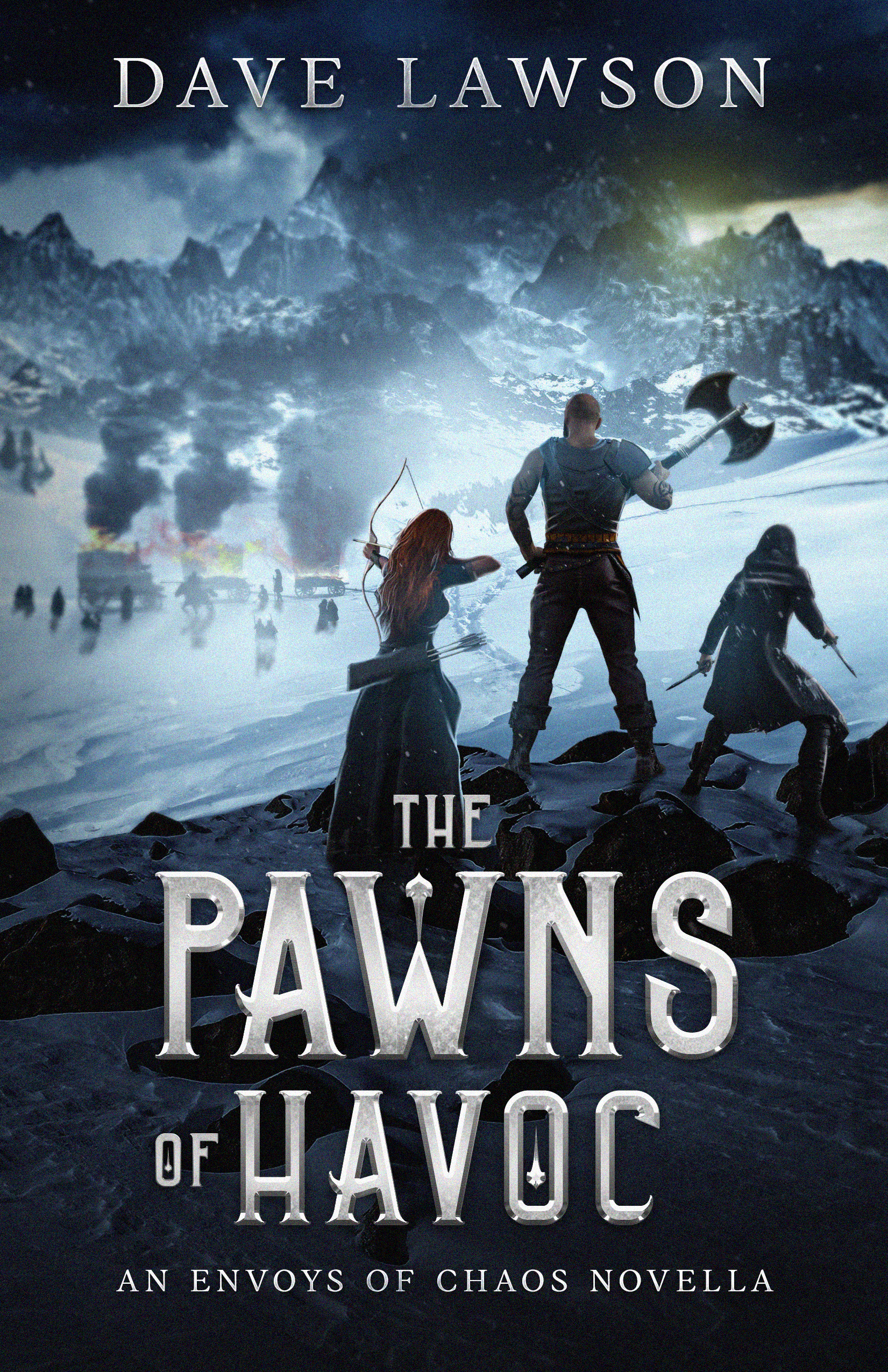
Dave Lawson is an author I’ve been meaning to read for ages, and I’m glad I got the opportunity to do so through SFINCS. His entry, the secondary world fantasy, The Pawns of Havoc, is a prequel story in his Envoys of Chaos series, but is presented here as a standalone. Although the setting is clearly epic, with all the detailed particularity expected from the genre, Pawns is easy to follow and Lawson keeps the lens zoomed-in on present action, conflict, and only the most relevant worldbuilding. With its mercenaries, ne’er do wells, and mysterious baddies,  it should appeal to epic fantasy fans who enjoy a mixture of humour and Marvel-style banter with a dash of edginess. Although it won’t rewrite the genre, it’s a smooth, polished read and, I suspect, a crowd-pleaser.
The Pawns of Havoc follows Cork, a deceptively simple man who has been forced into a mercenary lifestyle out of desperation. Cork is part human and part Winn–the Winn being an isolated and mysterious species who are viewed with suspicion outside their homeland. Part of this suspicion is due to the Winn’s affliction, which prevents anyone who has spent an extended period of time in their homeland from safely existing outside it without developing a debilitating illness that precedes their death. Cork’s mother is just so stricken, and it is out of the necessity to afford medicines to heal her that Cork reluctantly takes a job to assemble a team and attack a convoy. Of course, there is more to the seemingly straightforward task than meets the eye, and the moral quandary over whether or not to fulfill the contract heightens the already palpable tension between Cork and his two teammates: the archer Arabella and the merciless Nessa.
The writing in Pawns is incredibly smooth and polished, and the novella is an easy read that steadily clips along thanks to Lawson’s strong command of character voice and dialogue. Although there are hidden motivations and subtle nuances to Cork’s character, in terms of his presentation and speech he’s very straightforward, and Lawson wisely chooses to honour that through sparse use of narration and an emphasis on the back-and-forth between Cork and his teammates. While there’s not much in the way of sentence variation, I’m unsure whether that’s truly an issue when it feels as though it’s part of Cork’s character. That said, one of the few areas where there was some awkwardness was, for me, in Cork’s accent. Accents in fiction are a contentious topic no matter the author, and while Cork’s didn’t ruin the novella by any means, it was distracting and challenging to place (both Cork’s name and some of the characteristics of his speech suggest Ireland, but I suspect this was a fantastic version of a type of Irish accent). Certainly, it communicates a kind of fictional Irishness that’s not uncommon in fantasy and helps sketch Cork as an archetype. For me, it did a bit of a disservice to Lawson’s characterization of Cork, who otherwise bucks against expectation as the story unfolds.
Cork couldn’t look at her. Not for more than a few moments. The woman who’d been so strong in his childhood, now so weak she struggled to walk across a room.
Much of the heart of the novella came through for me in its latter half, and it’s here where Lawson explores Cork as a person more fully. While the plucky feel of the intro and the familiarity of the fantasy set pieces in the opening are likely to draw readers in, its in the darker and more intimate moments of the second half of the novella that Lawson most shines as a writer. Both Arabella and Nessa remain largely archetypal (Arabella the feisty but ultimately soft-hearted love interest and Nessa the ruthless female warrior), yet since the focus of Pawns is really in crafting a more well-rounded picture of Cork, this isn’t necessarily an issue so much as a way of foregrounding the aspects of the story that the reader ought to pay attention to. While Arabella is thus largely a sounding board that allows entry into Cork’s character, I was happy for her to do so and I was able to more fully feel Cork on page due to their shared scenes later on. Likewise, Cork’s relationship with his mother helps create sympathy for him and provides an opportunity for the reader to get to know him. Perhaps more controversially, there is a tonal shift from the humour of the first half to the harsh moral choices of the second, and reader responses to this will likely be highly personal, but it’s also a shift that arguably allows Lawson to showcase the range of what one might find in the larger Envoys series. That Lawson is more than capable of achieving both tones on page speaks to his abilities as a writer and sets him up as a writer to watch.
From the perspective of a newcomer to the Envoys series, The Pawns of Havoc did a great job introducing me to the world, showcasing Lawson’s talent, and making me curious about the roles of both Cork and the Winn in the larger series. While it stands on its own as a story, it left me wanting to read more about Lawson’s characters and world. The Winn in particular are enjoyably weird and I’m a sucker for cursed ailments, isolated cultures, and moral ambiguity. Although Pawns is dependent on a lot of well-worn epic fantasy motifs and elements, there’s enough that’s intriguing that I can recommend picking it up to see if its mysteries intrigue you the way they did me, and for epic fantasy fans who prefer the familiar to books focused on upsetting the genre, Pawns is a fantastic introduction to what indie fantasy has to contribute to the tradition.
Buy The Pawns of Havoc from Amazon.
Add The Pawns of Havoc on Goodreads.
Add The Pawns of Havoc on Pagebound.