

“No one is coming for us unless I fetch them.”
“Then no one is coming.”
C. J. Lavigne’s The Drowned Man’s Daughter was a rare read for me, one that inspired that much-sought after experience: a book hangover. A work of post-apocalyptic fiction that features a zombie-like infection transferred by a parasitic moss, TDMD also tickled my academic curiosity. It’s always a risk for me when I pick up a new book in a genre I study as part of my research–the more immersed you become in a specific subgenre (even a really niche genre like speculative fungal fiction and its sisters), the more visible the strings suspending your disbelief. Happily, Lavigne’s novella isn’t a simple rehash of tired concepts, but a worthy new entry in an already rich tradition. I recommend The Drowned Man’s Daughter to fans of Waubgeshig Rice’s Moon of the Crusted Snow, Aliya Whiteley’s The Beauty, J. Patricia Anderson’s Your Blood and Bones, Mike Carey’s The Girl With All the Gifts, and the sweeping, tense, and textured world of 28 Weeks Later.
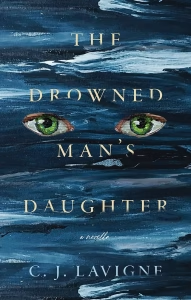

The world of The Drowned Man’s Daughter feels out of place and time in a way that lends it a fabulous quality–an element that plays into the story’s premise and the way the narrative centres storytelling, tradition, and belief. Part of the reason for this is that Lavigne feeds the reader worldbuilding information crumb by crumb. Stray plastic harvested from the water by the survivors suggest past cataclysm, while the depth and detail of the enclave’s beliefs and mythology point to a somewhat distant societal collapse. Seemingly concrete elements in the story such as the mer and the seals introduce some ambiguity when it comes to the nature of Naia’s world. Are the mer what they seem to be, and, if so, how did they come to be? Are the “seals” who attack the islanders seals in the way we understand the word, or something Other? As TDMD continues, elements of the setting and context that initially feel confusing either coalesce, or reveal themselves to be intentional ambiguities that add to the mythic quality of the storytelling. There’s a prevailing sense of the characters’ isolation in the world the further into the story one reads.
At the level of prose, Lavigne knows when a quiet sentence is more effective than ostentation, and while there are quotable lines aplenty to showcase how sharp or elegant a writer she is, much of the power of what she’s doing lies in how seamless the writing becomes once you’re fully immersed in the story. It’s undeniably a beautifully-written book, yet it never feels at pains to convince you of its beauty. There’s a confidence in the craft that makes for an ease of reading, allowing you to flow along with the story and with Naia’s narration. Along those lines, Naia’s voice is conveyed both clearly and consistently, her care for others and worries for the world around her–her conflicts and her regrets–all feel so real in part due to the strength of the line-level writing.
“It struck me that Petyr was right–not because he walked from the surf like a god, but because we who stood on shore were straggling, and clothes needed mending, and bones needed meat and everyone was dusted with the same salt-charcoal greyness.”
That Lavigne is able to make the audience care so deeply, so quickly, about a relatively large number of characters is impressive. While I had a clear sense of each character by the end, part of what undergirds the strength of the larger cast is Naia’s own characterization. Her perspective on each of the others–the love and care she feels for them, alongside the heartbreaking sense of a child’s guilt when she fails to live up to their expectations of her–breathes life into the interpersonal dynamics that drive the emotional side of the story. When I started the book, I didn’t expect to grow so attached to the fates of Naia’s family, but there were moments of personal devastation that I suspect will stay with me years after reading. A huge part of that is due to how realistically events seem to unfold, despite the fantastical and science fiction set pieces. When Naia experiences grief, or the younger children she’s tending express joy and hope, it’s conveyed with such real and raw honesty that you can’t help but experience it alongside them. Caught between the weight of mythic storytelling and the fickle temper of an unforgiving environment, Naia and her community feel terribly real while also being pawns inside a story that’s hopelessly out of their control.
There’s a beautiful and haunting solastalgia to The Drowned Man’s Daughter–a mournfulness that bleeds from the pages.The novella left me with the ache in my chest that only a good story well told can inspire, and while I can’t say it’s the strongest SFINCS entrant I’ve read in SFINCS4 (because it’s the first), I can say that it’s one of the best books I’ve read all year and that I enjoyed it so much that I worried throughout the writing of this review that I wasn’t doing it justice. A book that deserves to be read and reread. If you find at first that the opacity of its world is a barrier, I urge you to give it time to work its magic.