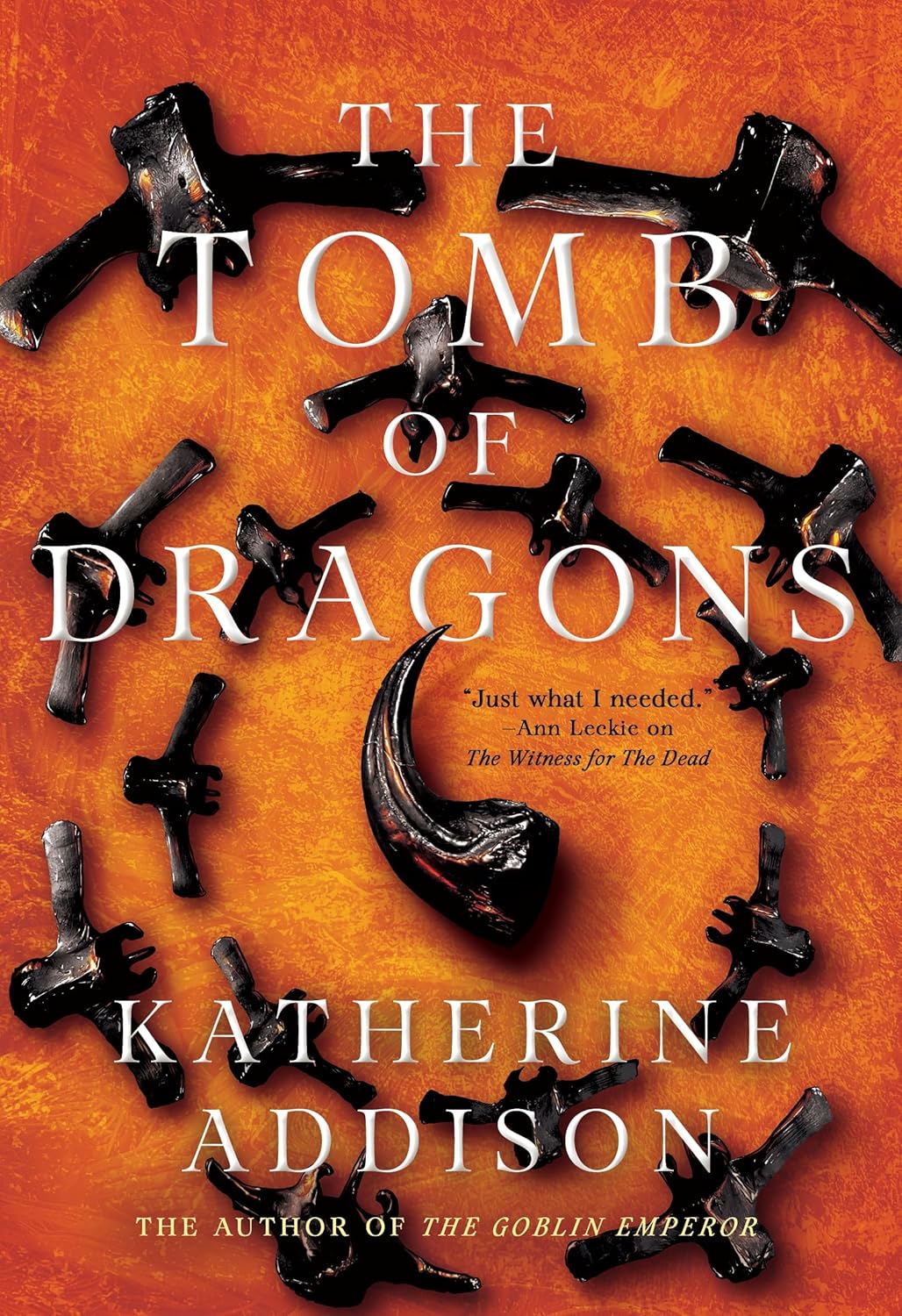
 What is The Tomb of Dragons?
In The Tomb of Dragons, Katherine Addison returns to the award-winning world of The Goblin Emperor, deftly wrapping up The Cemeteries of Amalo trilogy.
“This trilogy is as close to perfect as books can get.“—T. Kingfisher, author of What Moves the Dead
Thara Celehar has lost his ability to speak with the dead. When that title of Witness for the Dead is gone, what defines him?
While his title may be gone, his duties are not. Celehar contends with a municipal cemetery with fifty years of secrets, the damage of a revethavar he’s terrified to remember, and a group of miners who are more than willing to trade Celehar’s life for a chance at what they feel they’re owed.
Celehar does not have to face these impossible tasks alone. Joining him are his mentee Velhiro Tomasaran, still finding her footing with the investigative nature of their job; Iäna Pel-Thenhior, his beloved opera director friend and avid supporter; Anora Chanavar, his stalwart friend and fellow prelate of Ulis; and the valiant guard captain Hanu Olgarezh.
Amidst the backdrop of a murder and a brewing political uprising, Celehar must seek justice for those who cannot find it themselves under a tense political system. The repercussions of his quest are never as simple they seem, and Celehar’s own life and happiness hang in the balance.
Review
THE TOMB OF DRAGONS (The Chronicles of Osreth #4, The Cemeteries of Amalo #3) by Katherine Addison is her fourth book in the steampunk fantasy world of Osreth as well as third following the adventures of Thara Celehar, Witness of the Dead. I admit, I miss Maia from THE GOBLIN EMPEROR but I have come to treasure my experiences with Thara. He is a rare kind of protagonist in that he is older, a gay, nonconfrontational. and a figure who uses his words far more than he ever does his fists. He is far more the kind of protagonist you’d find in a mystery novel than you would your typical fantasy story and reminds me a bit of Brother Cadfael.
I very much enjoy the world of Osreth because it is an incredibly realized world and while the names may be a little hard to pronounce or remember, the idea of a fantasy world entering into its age of airships, photography, and trains is little-used enough that I enjoy reading about it. I remember the game ARCANUM: OF STEAMWORKS AND MAGIC OBSCURA and think Osreth is, bluntly, a better written version of this. There’s no gunpowder in Osreth, at least as far as I can tell, but it is a highly evolving world casting off the darkness of the old era.
The premise for this novel is that Thara is kidnapped by a group of disgruntled miners who take him to speak with the ghost of a dragon who has been killing people in “his” mountain. Thara finds out that the dragons of Osreth have been subject to a genocide and the roughly 170 odd mines in the region are all built over dead dragon’s homes. Dragons are very good at fighting knights, it turns out, but not so much poison gas pumped into their caves. I found that a clever little detail and one that added to the sense of Osreth as a changing place.
Thara finds it his job to serve as the witness for the dead dragons, even though a large chunk of the population don’t believe them to be people and there is an economic interest in making sure that the atrocity doesn’t come to light. Basically, some of the mines are still active and incredibly lucrative. So much so that bringing down the company that killed the dragons would result in the collapse of the Empire. There’s also a subplot about Thara losing his ability to talk to the dead, another murder at the opera, fixing a corrupt parish’s registry for the dead, and a local lordling escaping house arrest. All of which end up tying together as these things often do in stories.
So, is it any good? Yes, yes it is. I love Katherine Addison’s prose, her ability to make things as surreal as confronting a bureaucracy that has just given up on doing their jobs into a fascinating story. It reminds me a bit of Discworld and the Moist von Lipwig stories despite the fact Thara and he could not be less alike.However, I do have one complaint that knocks down the book a star rating or so because it is something that did affect my enjoyment: The story kind of wraps up way too neatly.
Thara is good friends with the Emperor, the evil corporate types keep digging a deeper hole for themselves, and much of the resolution requires nothing to be sacrificed by the “good guys.” I feel like when dealing with generational crimes, genocide, racism, and so on that you probably shouldn’t just have it be a simple solution. Worse, there’s several times where the book suggests that the good guys will have to compromise on justice that would have made a better story, in my humble opinion. Maybe recent events have just made believe happy endings in politics are just not very satisfying in and of themselves.
In conclusion, The Tomb of Dragons is very enjoyable if you liked the previous ones in the series then you’ll probably like this. I feel like the happy ending is a bit unearned, though, and I would have liked more difficulty in trying to satisfy the parties involved. As always with Katherine Addison, prepare to have great difficulty with the names.