


As a Pitch Wars alumnus and indie author, I’m pleased to participate in the Pitch Wars 2018 Indie Blog Tour! No, we haven’t time-travelled back to 2018 (one can dream). Fellow indie author and Pitch Wars 2018 alumna, T. C. Duck gathered a bunch of us PW authors who’d gone indie and suggested (then organized) a reunion blog tour during which we reflect on our Pitch Wars experiences, our post-Pitch Wars writing journeys, and the legacy of the program on our work.
Over the next three days, Before We Go Blog will be hosting interviews from three 2018 mentees!
Check out all the other great guest posts, reviews, and spotlights here!
ABOUT PITCH WARS
“Pitch Wars was a volunteer-run mentoring program where published/agented authors, editors, or industry interns chose one writer each to mentor our a month to three months period depending on the year. Mentors read the entire manuscript and offered suggestions on how to make the manuscript shine for the agent showcase at the end of the mentoring period. The mentor also helped edit their mentee’s pitch for the contest and their query letter for submitting to agents. Some mentors participated as solo mentors while others paired up with a co-mentor.” – From Pitch Wars founder Brenda Drake’s website.
INTERVIEW
For anyone who may not know you, can you introduce yourself to readers of Before We Go Blog?
Hi! I’m T. C. Duck, flight attendant, illustrator, and author of the Atrix Files. Under the name Theresa Duck, I participated in PitchWars 2018 as a mentee. I have a BFA in creative writing from the University of North Carolina Wilmington and worked as a children’s bookseller at Barnes & Noble for two years. I interned at Macmillan Children’s Publishing Group in 2017. My work is inspired by places I’ve traveled.
Can you tell us a little about your PW entry?
Sure! I was a Middle Grade entrant, and my book was titled DRUM CORPSE. I think I still have the pitch somewhere:
Lady Octavia’s is not your average music school. At this academy, students are expected to master dangerous weapon-instrument hybrids, and Pitch’s mother, the late Sonata Remington, was the best drum major the school has ever known.
Twelve-year-old Pitch dreams of following in her mother’s footsteps. But when a competition for first chair threatens her place at the academy, Pitch must unravel the mysteries of her mother’s past to master the secrets hidden within her piccolo. The more Pitch investigates, the more she realizes that sinister forces haunt Lady Octavia’s halls, and Sonata might not have been a hero after all.
So, yeah. It was an incredibly weird book, filled with music battles, magic instruments, and evil muses. Not super surprised the project didn’t go anywhere, but it was fun to write!
 What was the mentorship and showcase experience like for you?
I had a pretty great experience, despite running out of time and having to rush the ending. Sabrina Kleckner and I made a great pair. I learned so much about editing over the course of the competition, and while the book never found an agent, I’m a much better writer for it.
I do wish I’d had about two more months. Drum Corpse needed a lot of heavy rewriting. Sabrina helped me realize that the version of Drum Corpse I’d submitted to the program was all set-up and no payoff, a pretty common problem for young writers banking on selling a series. She helped me turn the manuscript into a more complete story. Unfortunately, that meant a heavy edit. I got about 80% of the way through my new outline before I ran out of time and had to tie things off quickly to make the showcase. I finished the book, just not the way I’d intended.
The good news is that every agent who had requested my full during the competition was willing to take a second look at the ending once I had time to finish it properly. I closed the project with around 30 requests, 17 of those being from Pitch Wars, but as the saying goes, it only takes one yes, and tragically, my yes never came. I’d gotten so close so many times! One agent had read my book on four separate occasions (a revise and resubmit pre-competition, a request during the showcase, and a second look after I changed the ending), but she ended up passing. Said the book was moving too slowly for her tastes, and I can’t help but wonder if that’s because she’d read it too many times.
I’ve always been drawn to the weird, the niche, the books that don’t fit easily into one category. I can’t be the only one out there.
Can you tell us about your post-PW experience(s)?
I’ve written three other books since Pitch Wars concluded, the first of which was another Middle Grade mystery, STRATOS. It was a MG sci-fi about tween girl who infiltrates an academy for giant robot pilots to find her father’s killer.
I still believe Stratos is one of my better novels. It has many similarities to Drum Corpse, but far fewer flaws. Unfortunately, I don’t think I got any requests over several years of querying it. Stratos was a tighter manuscript, but it was also a sci-fi, which is considered a “dead” genre in the MG market. Also, the MG market in America has faced a major downsizing over the past few years, leaving many long-time kidlit agents closed to MG.
Spider Island did marginally better. I managed to rack up a handful of requests, but I had a lot of the same problems querying it as I had with Stratos; that sticky trad concept of a “dead” genre. Spider Island is what I would call a fantasy technothriller. Structure-wise, it’s more similar to a Blake Crouch or Andy Weir book than your typical fantasy, but set in a modern, secondary world. I’ve tried pitching it as straight fantasy. I’ve tried pitching it as a thriller. Fantasy did a little better for me request-wise, but still, no luck from agents. There just wasn’t a lot of market precedent for this kind of story I’d written. Outside of Romantasy and cozy fantasy, cross-genre novels are still very much a hard sell in the adult space. The question I found myself facing from agents was, would folks who like science-thrillers really read a fantasy book and vice versa?
I mean, I definitely would, but I can’t speak for the majority of readers. It’s around this time I got really fed up with querying. I was writing great books, I knew I was, yet I couldn’t find an audience for them. They were all just a bit too weird. Too niche.
Cue Arbor Giants, which really thrust me into the indie space. Set in the same world as Spider Island, it’s fantasy technothriller about a team of arborists trying to scale a 10,000-foot world tree. I didn’t even bother querying this one. I knew I’d hit the same walls as I had with Spider Island, but now I had two adult books set in the same world. That meant I had a series, which meant I could self-publish.
Up until this point, I hadn’t really considered self-publishing. Indie markets are infamously terrible for Middle Grade, but with my adult fantasies, I actually stood a chance of making something of a career out of my writing. Maybe not a full-time career (I like being a flight attendant too much), but it’s better than having all these projects collecting dust in my laptop.
I won’t know until June how well Spider Island does. My gut tells me the market is there, but I’m realistic enough to know that those agents had legit concerns when it came to the overlap of fantasy and technothriller audiences. I also know that first books in self-published series tend to lose money, at least until the rest of the series is out. I’m persevering anyway, and hoping the quality of the work pushes me over that hill. I spent a lot of time making Spider Island as professional as possible, and I hope that effort shines through.
But despite the setbacks, I’m happy where I ended up. I’ve come to appreciate the freedom indie publishing has granted me, not just in terms of design (have you seen my special editions?) but also the freedom to write the kind of books I’d want to read. I’ve always been drawn to the weird, the niche, the books that don’t fit easily into one category. I can’t be the only one out there.
Is the PW legacy still felt, in your estimation (either personally, or in a broader community sense)?
Yes and no. There was a time when saying you were a mentee in Pitch Wars raised eyebrows. It was an incredibly competitive, high-profile competition, and saying you were chosen as a mentee told people you were serious about writing. That you had the stuff. I don’t see that much anymore. Now, when I tell people at conferences and on retreats that I was in Pitch Wars, I’m more often met with “oh, what’s that?” Not a bad thing necessarily, but I do miss having that feather in my cap.
What hasn’t faded is Pitch War’s impact on my writing. I no longer fear big edits. I’ve learned to recognize weaknesses in my writing and to do something about it. It’s so easy to get complacent in indie publishing. No one is going to stop you from hitting that big red “publish” button, so it’s easy to throw a manuscript to the world before it’s ready. A self-published author might see legitimate criticism and say, “Oh, I can’t do anything about that,” and “Well, they just aren’t my target audience.” Pitch Wars taught me that most problems, even big problems, are fixable—and it’s worth it to put in the effort, even if that effort goes unnoticed.
Your novel, Spider Island, is about a reality TV show. Pitch Wars wasn’t a reality competition, and yet I’ve always felt like it occupied an adjacent position for the literary community. Did your experiences or feelings about the contest itself influence Spider Island in any way?
I feel the same way about Pitch Wars. It might not be the type of competition where you have to vote your fellow writers off a deserted island, but there was definitely a competitive element to being selected as a mentee. At the end of the day, there are only so many clients an agent can take on, and only so many Big 5 contracts to go around. That’s just the vibe of trad publishing, though. I’ve definitely felt a shift as I’ve immersed myself in indie spaces. Less posturing and one-upmanship, more kindness and support. In a way, querying felt a little like being on Survivor (or Far Island Warrior, if we’re talking about my book). Indie feels like camping with friends.
That being said, I wouldn’t say I was thinking much of Pitch Wars when I wrote Spider Island. I definitely used some of those skills to tackle editing, but PW wasn’t on my mind.
But if I did enter a competition where I’d have to vote fellow writers off an island, I’d definitely stick with the indies. Indie authors will go to bat for each other, and that’s one thing I really appreciate about this community.
What’s coming up next for you as an author?
I talked a little about it above, but Spider Island will be out on ebook June 1st! The BackerKit for all physical editions will be running May 28th through June 30th, and Arbor Giants (hopefully) will be out sometime early 2027.
 Spider Island
Twelve contestants. Thirty-six days. One deserted island.
Spider-verse meets Lost in this epic fantasy thriller inspired by the hit show Survivor. When disaster strikes and the set of the Far Island’s most popular reality show vanishes, it’s up to a contestant, a medic, and a safety contractor to find the missing island and save the archipelago from destruction.
Technothriller with a twist, SPIDER ISLAND is the first in a series of stand-alone novels set in the same fantasy world. Urban settings, human characters, and low magic, this series explores the impact of modern technology in a fantastical world. Don’t miss this fast-paced, action-packed novel available for the first time in hardback, paperback, and special edition.
Author Bio
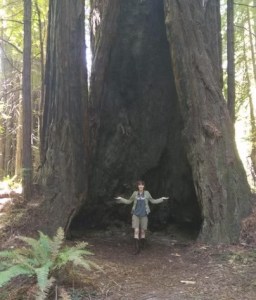 T. C. Duck is the author of the Atrix Files, including Spider Island and Arbor Giants. She received her BFA in creative writing from the University of North Carolina Wilmington and participated as a mentee in #PitchWars, 2018. She works as a flight attendant for Skywest Airlines. Her books are inspired by places she’s traveled.
Check out Spider Island on BackerKit
Read Spider Island on Kindle Unlimited
Learn more about T. C. ‘s work on her website!


